
A contractor losing bids they should have won, or winning ones they later wish they had lost, is usually not the victim of bad luck. It is the result of recognizable mistakes in how the estimate was put together. Some are obvious in hindsight, a missed scope item, a labor rate that did not match the market, a sub bid that was never properly leveled. Others are quieter, baked into routines that the team stopped questioning years ago. Either way they show up in the win rate, and the contractor who can name them is in a position to fix them.
This article walks through the mistakes that most consistently cost contractors jobs. The aim is not to argue that estimating is easy when it is done right. It is to call out the specific, identifiable patterns that turn a strong company into a weaker bidder, so any contractor reading this can audit their own process against them and address the ones that apply.
Why Win Rates Drift Without Anyone Noticing
Win rates rarely collapse. They drift. A company that was hitting one in four a few years ago might be hitting one in six now, and because the change happened across many bids over many months, it is easy to chalk up to a tougher market or pickier clients. Those are real factors, but they tend to be smaller than the internal ones. The market shifts a few points either way; estimating habits, left unexamined, can shift a lot more than that.
The mistakes below are the most common drivers of that drift. Most are not about skill. They are about discipline: small disciplines that hold up under steady volume and quietly break under pressure. A contractor who can spot which ones are showing up in their own bids can usually recover several points of win rate without changing anything about how the company sells or markets itself.
Mistake 1: Treating the Takeoff and the Estimate as the Same Thing
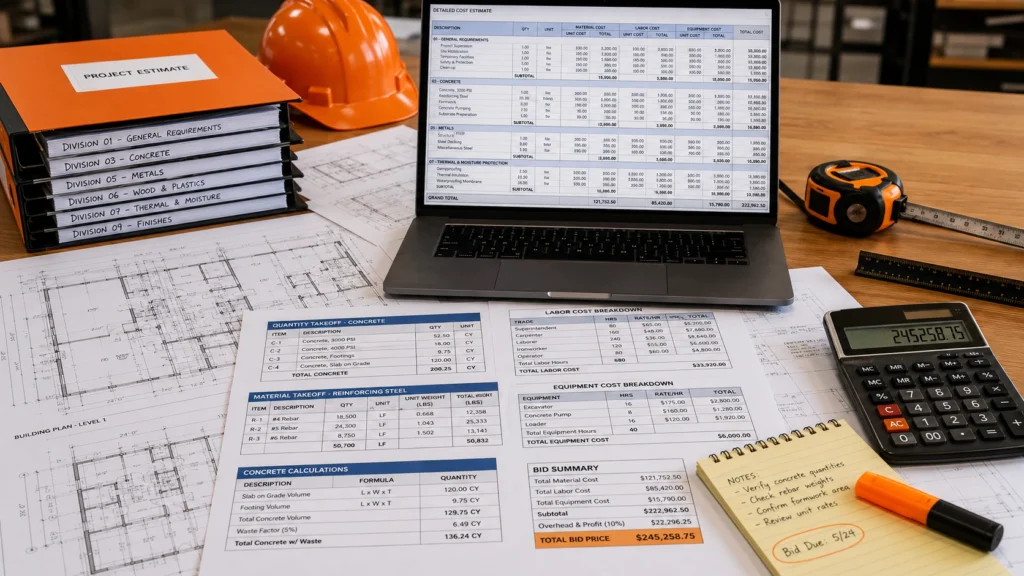
On a small job done by one person, the takeoff and the estimate blur together and no harm comes of it. As soon as the work involves multiple people or a serious deadline, the blur turns into mistakes. A team member produces a quantity list and someone treats it as a finished bid. A subcontractor sends what they call a takeoff that is really a rough price, and it gets leveled against properly measured bids as if it were the same kind of document. An early conceptual estimate, never backed by real measurement, gets quoted later as a firm number.
Each of these errors traces back to the same root: treating a measurement and a price as interchangeable when they are not. Keeping the language clear, and keeping the work clear, prevents most of them. Anyone working through a bid should know exactly which document they are looking at and what stage of certainty it represents. The clean line between a quantity takeoff and a finished priced estimate is the foundation that makes everything else in estimating possible to manage.
Mistake 2: Rushing the Takeoff
Almost every other mistake on this list either starts with or is made worse by a rushed takeoff. When the measurement is done in a hurry, scope gets missed, quantities get approximated, and details on the drawings that change those quantities get overlooked. The resulting estimate has the right format and the right line items, but the foundation under it is shaky. The bid is wrong before pricing ever touches it.
Rushed takeoffs usually trace to one of two causes. Either the bid period was too short because the invitation arrived late or the deadline left no room, or the estimating capacity was overcommitted and the takeoff was squeezed into whatever time remained. The first cause is sometimes outside the contractor’s control. The second is almost always inside it, and it is one of the clearest symptoms of the kind of estimating bottleneck that quietly degrades bid quality across many bids in a row. The takeoff cannot be both thorough and rushed, and a contractor who finds themselves consistently choosing rushed is not seeing a one-off problem.
Mistake 3: Assuming Scope Instead of Confirming It
An estimate is built on what the documents actually say, not on what the estimator thinks they probably mean. When drawings are unclear, the disciplined response is to draft a request for information and wait for the answer. The undisciplined response is to assume what was intended and price the assumption. Sometimes the assumption is correct. Often it is not, and when it is not, the gap between what was bid and what the project actually requires becomes the contractor’s problem after award.
The same pattern shows up with subcontractor bids. A sub returns a number with vague scope language, and rather than pinning down what is included and excluded, the estimator carries the bid forward as if the scope matched the documents. Discovering on bid day that two subs interpreted a scope item differently, or that nobody priced a piece of work that was clearly on the drawings, is how scope gaps slip through.
Mistake 4: Comparing Subcontractor Bids Without Leveling Them
Two subcontractor bids for the same trade are almost never directly comparable as submitted. One includes overhead and the other does not. One quotes union labor and the other quotes prevailing wage. One excludes a piece of scope that is critical to the work; the other includes it. Picking the lower number without leveling the bids is one of the fastest ways to inherit a scope gap that will surface during construction.
Proper leveling means walking through each sub bid line by line, identifying inclusions and exclusions, normalizing the numbers to the same basis, and confirming with each sub that the scope they priced matches the scope on the drawings. It takes time, which is why it gets skipped when the bid period is short, but skipping it is precisely how a low number becomes a margin problem on the job.
Mistake 5: Pricing With Stale Unit Costs
Unit costs in an estimating database have a shelf life. Material prices move. Labor rates change with the market and with the union contracts. Productivity numbers shift with the crew the company is actually running this year. When the database has not been updated, the estimate is being built on numbers that describe a market and a workforce that no longer exist, and the pricing carries that lag straight into the bid.
The fix is unglamorous: keep the cost database current, feed it the actual numbers from completed projects, and review it on a real schedule rather than only when an estimator notices a problem. It is the kind of work that never feels urgent until a string of losses or thin margins traces back to it.
Mistake 6: Mishandling Contingency
Contingency is one of the easiest line items to get wrong, either by leaving it out or by treating it as a blanket cushion. A bid with no contingency at all is a bid that assumes no surprises, which is rarely true, and the contractor absorbs the surprises out of margin. A bid with a heavy blanket contingency on every line is a bid that is not competitive on price, because the cushion is paying for risk that may not be there on a given project.
Contingency works best when it is sized to the actual risk on the specific job: heavier where the drawings are incomplete or the site is unknown, lighter where the scope is well defined and the contractor has done similar work many times. That kind of project-specific sizing requires the estimator to read the project, not just apply a percentage out of habit.
Mistake 7: Bidding Everything That Comes In
A contractor who bids every invitation that arrives, regardless of fit, is paying estimating cost on jobs that have low odds and competing for the attention that bids with real win probability would benefit from. The go or no-go decision exists precisely to filter the queue: which jobs match the company’s strengths, which clients pay reliably, which schedules are realistic. When that filter is skipped, the estimating function spreads itself thin across bids that were never going to land.
A disciplined go or no-go conversation does not have to be elaborate. A short, honest review of fit, capacity, and likelihood is enough. The point is to spend estimating hours on the bids that have a real chance, not to send a number on everything just because the invitation was received.
Mistake 8: Never Looking Back at Lost Bids
Most contractors never debrief a lost bid. The invitation closes, the job goes to someone else, and the team moves on to the next bid in the queue. The information sitting in that loss, what the winning number was, what scope might have been priced differently, whether the loss was about price or about a different relationship, never gets captured. The next bid is then prepared with the same assumptions as the last one.
A simple loss review, even a short one, builds the kind of historical knowledge that sharpens future estimates: which trades the company tends to be high on, where competitors are aggressive, which clients are price-driven and which value other factors. Without that loop, win rates have no way of improving by experience alone.
The Mistakes at a Glance
| Mistake | How it shows up | What it costs |
| Blurring takeoff and estimate | Treating a quantity list as a finished bid | Numbers carried forward without real measurement |
| Rushed takeoff | Measuring against the clock | Missed scope baked into the bid |
| Assumed scope | Pricing what is probably meant rather than asking | Scope gaps absorbed during construction |
| Unleveled sub bids | Picking the low number without normalizing | Inherited scope gaps from subs |
| Stale unit costs | Pricing from a database that has not been updated | Bids that lag the real market |
| Mishandled contingency | None at all, or a blanket cushion on everything | Either eroded margin or uncompetitive price |
| Bidding everything | No go or no-go filter | Estimating effort spent on low-probability bids |
| No loss review | Moving on without debriefing | The same mistakes repeating across bids |
Most of These Mistakes Are Workflow Problems
Reading the list, a pattern emerges. Almost none of these mistakes happen because the estimator does not know better. They happen because the bid process does not give the estimator the time, the structure, or the information to do better. A workflow that consistently produces rushed takeoffs, skipped sub leveling, and no time for loss review is a workflow that will keep producing those mistakes regardless of who is doing the estimating.
Fixing them one at a time is useful, but the larger lift is designing a bid workflow that keeps the disciplines intact even when the calendar is full. Capacity, sequencing, and clear ownership of each stage are what make it possible to take time on the takeoff, level the sub bids properly, keep the cost database current, and run the go or no-go conversation that a healthy estimating function depends on.

How VCA Helps Contractors Avoid These Mistakes
Several of the mistakes on this list trace back to one root cause: an in-house estimator with too many bids and not enough hours. Virtual Construction Assistants (VCA) addresses that root cause directly. A construction virtual assistant trained in estimating handles the takeoffs, the bid package assembly, the sub bid tracking, and the scope sheets, which is what gives the in-house estimator the time to confirm scope, level sub bids properly, and keep the company’s pricing current.
A construction estimator VA arrangement does not replace the contractor’s pricing judgment, since that is not what was missing. It restores the conditions under which the estimator can apply that judgment properly, instead of being so deep in production work that the disciplines this article describes get squeezed out of every bid. The mistakes shrink when the estimator has room to work the way they already know how to work.
Frequently Asked Questions
What are the most common estimating mistakes in construction?
The most common are rushed takeoffs, assuming scope instead of confirming it, comparing subcontractor bids without leveling them, pricing with stale unit costs, mishandling contingency, bidding every invitation regardless of fit, and never debriefing lost bids. Most show up in win rates over time rather than as a single dramatic failure.
Why do contractors lose bids they should have won?
Often because the bid carried hidden mistakes: missed scope from a rushed takeoff, assumptions that priced the wrong work, sub bids that were not properly leveled, or contingency that was either too thin to absorb risk or too heavy to be competitive. The mistakes are usually small individually and add up across many bids.
What is the single biggest cause of estimating errors?
Time pressure on the takeoff is the most common single cause. When measurement is rushed, scope gets missed, quantities get approximated, and drawing details that change quantities get overlooked. Almost every other estimating mistake is either started or worsened by a takeoff that did not get the time it needed.
How can a contractor reduce estimating mistakes?
By giving the takeoff enough time, drafting requests for information instead of assuming scope, leveling subcontractor bids before comparing them, keeping the unit cost database current, sizing contingency to the actual project risk, running a go or no-go conversation on every invitation, and debriefing lost bids. Most of these are workflow disciplines rather than skill issues.
Does estimating software prevent mistakes?
Software helps with consistency and speed, but it does not prevent mistakes that originate in the inputs or the process. A takeoff tool will tally the quantities a measurer marks up, but it cannot catch a wall the measurer missed. Pricing software will apply the unit costs in the database, but it cannot fix unit costs that have not been updated. Software supports good practice; it does not replace it.
Are estimating mistakes more common on rushed bids?
Yes. Rushed bids consistently carry more missed scope, weaker sub leveling, and stronger reliance on assumptions, because the disciplines that prevent those mistakes all take time. A contractor who notices that mistakes cluster on rushed bids is seeing a symptom of capacity strain rather than a skill problem.
Sharpen the Bids by Fixing What Quietly Costs You
Win rates respond to discipline as much as to anything else. The contractor who closes the gaps this article describes, the rushed takeoffs, the assumed scope, the unleveled sub bids, the stale costs, the missing loss reviews, will see the win rate move without changing anything about the sales side of the business. Most of these are not big lifts individually. They are small habits that hold up when the bid process has room to breathe and break down when it does not.
Virtual Construction Assistants (VCA) gives contractors that room. By moving the production work to trained outside support, the in-house estimator gets back the hours that the disciplines on this list require. The broader case for outsourced construction estimating is built around exactly this idea: most estimating problems are easier to solve when the estimator is not the one measuring every job.