
Construction Bookkeeping and Accounting Services

Construction accounting is not like running the books for a retail store or a consulting firm. Between job costing across multiple active projects, AIA billing cycles, retainage, subcontractor compliance, and prevailing wage requirements, the financial side of a contracting business demands specialized attention from day one.
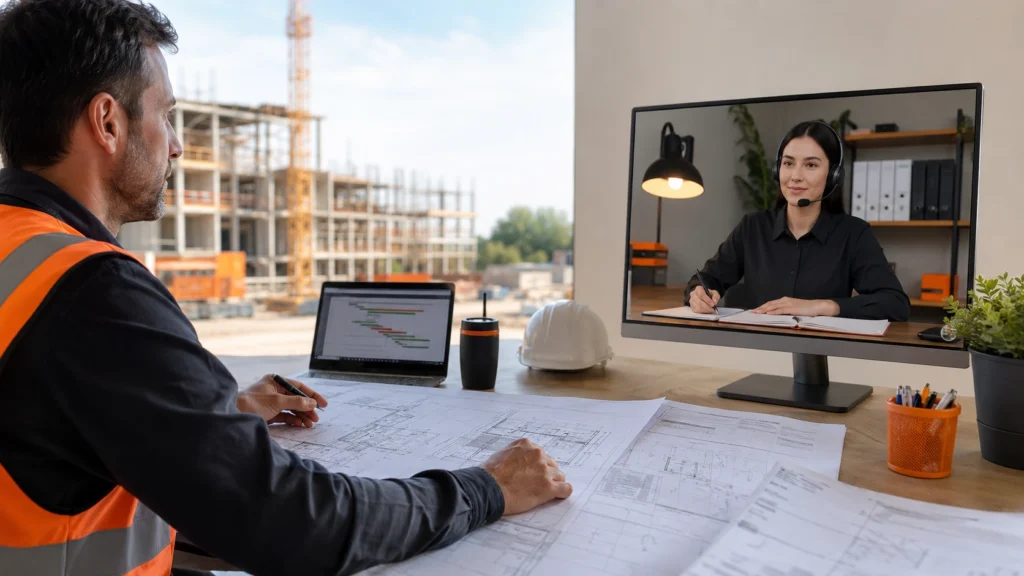
That is exactly what Virtual Construction Assistants (VCA) provides. We deliver dedicated construction bookkeeping and accounting services to contractors, builders, and engineering firms across the United States. Every financial professional we place has direct experience working in the construction industry, so there is no learning curve, no hand-holding, and no months of training before they can read a set of plans or process an AIA pay application.
Whether you are a general contractor managing fifteen active jobs or a specialty trade running a lean crew, we match you with a bookkeeper or accountant who already understands how your business works.
What a Construction Bookkeeper Actually Does
A bookkeeper working for a construction company does not just categorize transactions and reconcile bank statements. Those tasks are table stakes. In construction, a skilled bookkeeper is the person who keeps your job cost reports accurate, your billings on schedule, your subcontractor payments documented, and your financial statements clean enough that your CPA, lender, or bonding company can rely on them without follow-up questions.
Here is what that looks like in practice on a day-to-day basis:
- Tracking every dollar of cost at the project level, broken down by labor, materials, subcontractors, equipment, and overhead
- Managing progress billings, schedule of values updates, and AIA G702/G703 pay applications
- Processing certified payroll reports and maintaining compliance with prevailing wage rules
- Reconciling all bank accounts and credit cards, including project-specific trust accounts
- Handling accounts payable so vendors and subcontractors get paid on time and lien waivers are collected
- Following up on accounts receivable, tracking retainage balances, and flagging overdue invoices before they become cash flow problems
- Preparing monthly financial statements, job profitability reports, and work-in-progress schedules
The difference between a generalist bookkeeper and someone who has worked in construction is that the generalist will need you to explain what retainage is, why your revenue recognition is project-based, and how to set up a chart of accounts that separates direct job costs from overhead. A construction-experienced bookkeeper already knows all of this. They start contributing immediately.
Bookkeeping and Accounting Services Built for Contractors
We built our service offering around the actual financial workflows that contractors deal with every week. This is not a menu of generic accounting tasks with “construction” added to the label. Every service below reflects how construction companies actually operate, bill, and get paid.
Job Costing and Profitability Analysis
Job costing is the foundation of any well-run contracting business. Your bookkeeper tracks all direct and indirect costs at the individual project level so you can see exactly where money is going, which jobs are profitable, and where overruns are developing before they become serious. Over time, accurate job cost data also makes your estimates sharper. Contractors who know their real cost history by trade, project type, and crew size consistently bid more accurately than those who are guessing. If your team also needs support on the estimating side, our construction estimator can work alongside your bookkeeper to close that loop between past project data and future bids.
Day-to-Day Financial Management
This covers the essential daily and weekly bookkeeping operations that keep your records accurate: recording and categorizing transactions, maintaining your general ledger, managing your chart of accounts, and keeping everything organized and audit-ready. In construction, this also means understanding how to allocate expenses correctly across multiple active projects, separate direct costs from overhead, and handle the timing differences that make construction accounting more complex than most industries.
Billing, Invoicing, and Collections
Delayed invoices lead to delayed payments, which creates the cash flow gaps that stall projects. We manage your entire billing cycle, from progress billings and AIA pay applications to schedule of values updates and final invoices. We also stay on top of outstanding receivables and follow up on overdue balances so your money keeps moving.
Accounts Payable and Vendor Payments
We organize incoming vendor bills, schedule payments according to your contract terms, and make sure subcontractors and suppliers get paid on time. We also maintain the lien waiver documentation you need to protect your rights on every project. Keeping payables current protects your supplier relationships and prevents the kind of payment disputes that can delay project timelines.
Bank and Credit Card Reconciliations
Monthly reconciliations are how you catch errors, flag unauthorized charges, and confirm that your books actually match your bank balances. We reconcile all accounts, including any project-specific accounts, so your financial statements are always reliable.
Financial Statements and Reporting
We prepare the income statements, balance sheets, cash flow reports, and WIP schedules that contractors need. Whether the audience is your own management team, your CPA at year-end, a lender evaluating a loan, or a bonding company assessing your capacity, we deliver clear and accurate documentation that meets construction industry standards.
Payroll and Labor Cost Tracking
We handle payroll processing, certified payroll reports, prevailing wage compliance, union payroll requirements, and proper job-code allocation of labor costs across projects. Getting payroll right matters for both compliance and job cost accuracy, so we treat it as a core part of the service, not an afterthought.
When You Need More Than Bookkeeping
Some construction companies need support that goes beyond daily bookkeeping. That might mean financial statement preparation for a bonding application, cash flow forecasting across a pipeline of upcoming projects, WIP schedule preparation, or tax planning support heading into year-end.
Virtual Construction Assistants (VCA) provides accounting services for contractors who need this higher level of financial oversight. Our accounting professionals work alongside your CPA or independently, depending on your setup. They understand the specific reporting requirements that lenders, bonding companies, and tax advisors expect from construction businesses, including percentage-of-completion reporting, completed-contract method documentation, and project-level profitability analysis.
If you are not sure whether you need a bookkeeper, an accountant, or both, we can help you figure that out during your initial consultation.
Why Contractors Choose Virtual Construction Assistants (VCA)
Most bookkeeping firms that claim to serve contractors are really generalist accounting companies that happen to have a construction client or two on their roster. The person handling your books might also be doing bookkeeping for a dental office and a marketing agency. That is not specialization.
Virtual Construction Assistants (VCA) works exclusively with the construction industry. Every professional on our team has been trained in or has direct experience with construction workflows, software, terminology, and compliance requirements. When we assign someone to your account, they already understand what an RFI is, how retainage works, and why your billing cycle does not follow a standard 30-day invoice pattern.
Here is what that specialization means for your business:
- Your bookkeeper is productive from the first week, not after months of training on your industry
- Job cost reports are set up correctly from the start, structured around how construction projects actually flow
- Your financial statements meet the standards that bonding companies and construction lenders expect to see
- You spend less time explaining your business and more time actually running it
- The cost is significantly lower than hiring a full-time in-house bookkeeper or accountant, with no overhead and no long-term contract
Software and Platforms We Work With
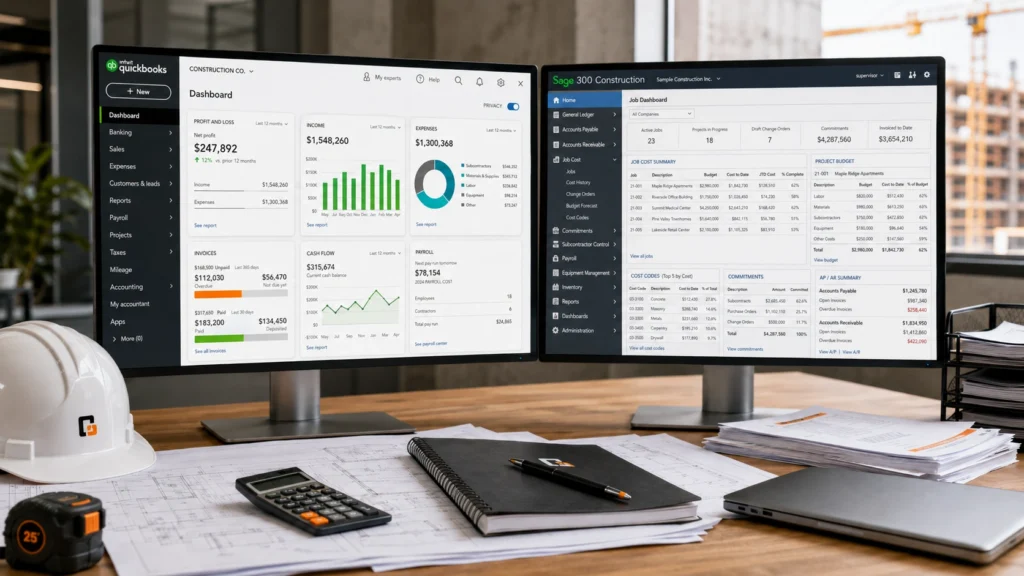
Our team works with the accounting and project management platforms that contractors use every day:
- QuickBooks Online and QuickBooks Desktop (including QuickBooks for Contractors)
- Sage 300 Construction, Foundation Software, and CMiC
- Buildertrend, Procore, CoConstruct, and other construction management tools
- Viewpoint Vista, Jonas Construction, and Acumatica
- AIA billing platforms and schedule of values tools
If you use something that is not on this list, ask us. We will match you with someone who already knows it.
We Work With Every Type of Contractor
Construction is not one industry. A general contractor managing twenty subcontractors has completely different bookkeeping needs than a two-person roofing crew. We match you with a financial professional who understands the specific way your type of business operates.
General Contractors
GC bookkeeping involves tracking costs across multiple overlapping projects, managing subcontractor payments and lien waiver collection, handling complex AIA billing cycles, and maintaining compliance documentation at scale. The bookkeeper we assign to a general contractor understands how GC operations differ from specialty trades and manages the books accordingly.
Specialty Trade Contractors
Whether you run an electrical, plumbing, HVAC, roofing, framing, or drywall business, we structure your bookkeeping around the way your projects are priced and executed. That means tracking material costs, equipment, and labor at the job level so your future estimates get tighter with every project you complete.
Homebuilders and Residential Builders
Custom home building and residential construction have their own financial rhythms: draw schedules, construction loan reconciliation, buyer change orders, and phase-based cost tracking. Whether you build one home at a time or manage a pipeline of spec builds, we keep the finances organized through every stage of construction.
Small Contractors and Growing Businesses
If you cannot justify the cost of a full-time in-house bookkeeper but you have outgrown doing the books yourself on evenings and weekends, you are exactly who we built this for. A dedicated bookkeeper from Virtual Construction Assistants (VCA) gives you professional financial management at a fraction of the cost of a full-time employee, with no overhead, no benefits to cover, and no long-term commitment.
Commercial Contractors and Remodelers
We also support commercial construction companies and remodeling contractors with full bookkeeping and accounting services. We adapt to your contract structure, project size, and reporting requirements.
How to Get Started
Getting set up is straightforward and there is no commitment required to have the initial conversation.
Step 1: Free Consultation
Tell us about your business, your current bookkeeping setup, and the financial challenges that are taking up your time. We work remotely with contractors across the country, so location is not a barrier. You get access to specialized construction bookkeeping expertise regardless of where your business is based.
Step 2: We Match You With the Right Person
Based on your business type, software, project volume, and scope of work, we identify the right bookkeeper or accountant for your needs. We handle onboarding and software access so your new team member gets up to speed quickly.
Step 3: Ongoing Partnership
Your bookkeeper maintains your books, scales with your workload, and proactively looks for ways to improve your financial processes. The goal is a long-term relationship that helps your construction business make better financial decisions on every project.
Frequently Asked Questions About Construction Bookkeeping and Accounting
Standard bookkeeping tracks income and expenses for one business entity on a monthly or quarterly cycle. Construction adds layers of complexity that general bookkeepers are usually not trained for: tracking costs at the individual project level, billing based on percentage of completion or AIA schedules, managing retainage withheld by clients, collecting subcontractor lien waivers, and complying with tax methods specific to the industry like the look-back rule. A bookkeeper without construction experience will consistently struggle with these requirements, which is why contractors end up frustrated with generalist firms.
The core responsibilities include general ledger maintenance, job costing, accounts payable and receivable, billing and invoicing, bank reconciliations, payroll processing, and financial reporting. In construction specifically, the bookkeeper also handles certified payroll, AIA pay applications, retainage tracking, subcontractor payment documentation, change order accounting, and cost allocation across multiple simultaneous projects. The exact scope depends on the size of your business and how many active projects you run at any given time.
Because construction revenue and expenses are tied to individual projects, not monthly sales cycles. A contractor might look profitable on paper while actually losing money on specific jobs. Proper bookkeeping for a contracting business means tracking project-based revenue and costs, managing the irregular cash flow that comes with milestone billing, accounting for equipment depreciation, handling materials purchasing across multiple jobs, and allocating labor by trade and project. When this is done poorly, contractors lose profitability without understanding why until it is too late.
Prioritize providers with direct, hands-on experience in the construction industry. The right provider should understand job costing, AIA billing, retainage, and construction-specific tax rules without needing a crash course from you. Look for familiarity with the software you already use, a track record with contractors of similar size and project type, transparent pricing, and the flexibility to scale up or down with your workload. If you have to spend your first month educating your bookkeeper about how construction works, you have the wrong provider.
It is organized around projects rather than time periods. While most businesses close their books monthly, construction bookkeeping requires tracking costs at the job level throughout a project’s entire lifecycle, which can span months or even years. This project-based structure affects everything: the chart of accounts design, the billing process, the way financial statements are prepared, and even how revenue is recognized. Most construction companies use the Percentage-of-Completion Method (PCM) or the Completed-Contract Method (CCM), each with different implications for tax planning and financial reporting.
General contractors have an additional layer of financial complexity. A GC tracks not only their own direct costs but also every subcontractor’s costs, retainage withheld from subs, lien waiver documentation for each sub on each project, and the flow of funds between the property owner, the GC, and subcontractors. GC bookkeeping also requires detailed AIA billing management, including schedule of values preparation and G702/G703 documentation. These requirements make it critical to work with someone who has specific GC experience, not just general construction knowledge.
Yes, and arguably more than large firms. Small contractors are more vulnerable to cash flow problems, billing mistakes, and tax surprises because they lack the internal financial infrastructure that bigger companies have. Professional bookkeeping helps small construction business owners understand their true project margins, plan for slow seasons, stay current on subcontractor and supplier payments, and file accurate tax returns. The cost of working with Virtual Construction Assistants (VCA) is a fraction of what a full-time hire would cost, which makes it practical even for smaller operations.
Most contractors use the Percentage-of-Completion Method (PCM), which recognizes revenue and expenses based on how far along a project is. This gives the most realistic picture of financial performance for long-duration projects. Smaller contractors with shorter project cycles sometimes prefer the Completed-Contract Method (CCM), which defers everything until a project is fully complete. The best choice depends on your project size, contract structure, lender requirements, and tax strategy. We can help you evaluate the right approach during your consultation.
Yes. QuickBooks is one of the most widely used platforms in the industry, and our team is highly experienced with both QuickBooks Online and QuickBooks Desktop. It handles job costing, progress invoicing, subcontractor payments, and integrates well with tools like Buildertrend and Procore. For larger companies with more complex needs, platforms like Sage 300 Construction, CMiC, Foundation Software, or Viewpoint Vista may be a better fit. Our team works across all of them.
The cost depends on the scope of work, the complexity of your projects, and the level of experience required. Hiring through Virtual Construction Assistants (VCA) typically costs significantly less than bringing on a full-time employee when you factor in salary, benefits, office space, and software licenses. We offer dedicated construction bookkeeping professionals at competitive rates with no long-term commitment. The best way to get an accurate number is to schedule a free consultation so we can understand your specific needs.
You get experienced professionals who specialize in construction without the cost of full-time employment. Outsourcing eliminates the training period that comes with hiring a generalist, reduces the risk of turnover, and gives you the flexibility to adjust your level of support based on project volume. With Virtual Construction Assistants, you also get the benefit of working with a team that has seen how hundreds of construction businesses manage their finances, so we bring best practices and efficiency that a single in-house hire typically cannot match.
Look for a provider with verifiable experience in the construction industry, knowledge of the accounting software you use, the ability to handle your project volume and complexity, and a reputation for accuracy and responsiveness. Ask them how many construction clients they work with and whether they understand your specific trade. Virtual Construction Assistants (VCA) works exclusively with the construction industry and serves contractors across the United States. Schedule a free consultation to see if we are the right fit for your business.
Ready to Get Your Books in Order?
If you are spending your evenings doing data entry instead of estimating your next job, or if you are not confident that your financial reports are accurate enough to support your next bid or bonding application, it is time to bring in someone who does this every day for contractors like you.
Virtual Construction Assistants (VCA) is ready to match you with a dedicated bookkeeper or accountant who understands the construction industry from the inside. We serve contractors of every size and trade across the country.
Reach out today to schedule a free consultation and take the first step toward cleaner books, better job cost visibility, and a more profitable business.
Contact Us to Discuss Your Construction Staffing Needs
Connect with us
Connect with us
support@virtualconstructionassistants.com