
Summary:
An accounting virtual assistant helps construction companies streamline bookkeeping, accounts receivable, subcontractor compliance, and financial administration while business owners retain control over strategic financial decisions, payroll approval, and capital planning.
Key Takeaways:
- Outsource transaction processing: Delegate bookkeeping, expense categorization, bank reconciliations, and account management to keep financial records accurate.
- Keep strategic decisions in-house: Maintain control over capital investments, financial planning, banking relationships, and major business decisions.
- Manage subcontractor compliance: Have a VA track insurance certificates, lien waivers, and documentation to reduce administrative workload.
- Support payroll administration: Let a VA prepare payroll data while management retains final approval and handles sensitive HR decisions.
- Improve cash flow: Outsource invoice follow-ups, collections, and accounts receivable management to speed up payments.
- Use construction-specific expertise: Choose a VA familiar with retainage, WIP reporting, job costing, and construction accounting workflows.
- Scale efficiently: Gain professional accounting support without the expense of hiring a full in-house accounting department.
Bottom Line:
A construction accounting virtual assistant handles the day-to-day financial administration that keeps projects and cash flow organized, while company leadership retains control of strategic financial decisions and business growth.
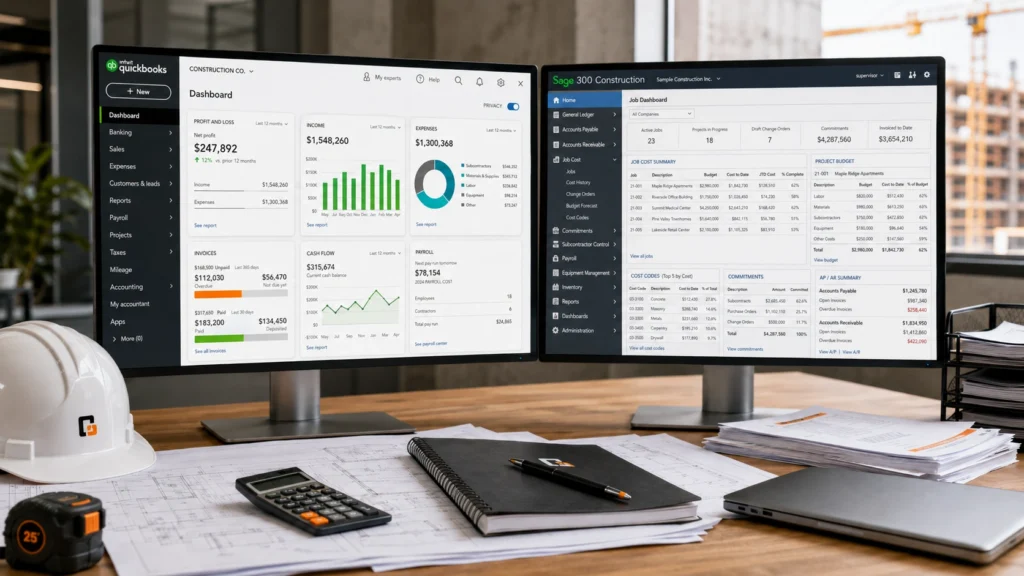
Scaling a construction company requires a transition from “shoebox accounting” to a sophisticated financial system that can withstand audits and support high-level bonding. However, the overhead of a full-time, in-house accounting department is often prohibitive for mid-sized firms and specialty contractors. By leveraging an industry-trained accounting virtual assistant, business owners can maintain a lean office while ensuring their books remain current. The key to a successful remote partnership lies in understanding which high-volume technical tasks are best for outsourcing and which strategic financial decisions must stay in the hands of the firm’s leadership.
Outsource: High-Volume Transaction Processing and Categorization
The most immediate drain on a contractor’s time is the daily management of bank feeds and credit card transactions. A virtual assistant monitors bank activity within QuickBooks or Sage, ensuring every hardware store run or fuel charge is immediately categorized to the correct cost code. This prevents the end-of-quarter scramble to identify old receipts and ensures that financial reports are based on real-time data rather than guesswork.
Beyond categorization, the assistant manages the reconciliation of bank statements, loan accounts, and credit lines. They ensure the digital record matches the bank’s reality down to the cent. Moving this repetitive technical work to a remote professional eliminates the clerical errors that often lead to inaccurate tax filings or misleading profit-and-loss statements.
Keep In-House: Strategic Financial Planning and Capital Allocation
While a virtual assistant can provide the data, they should not be the ones making high-stakes decisions regarding the firm’s capital. Strategic planning, such as deciding when to purchase heavy equipment versus leasing, remains an in-house function. The business owner must retain control over the firm’s investment strategy and the allocation of profits toward growth or debt reduction.
Internal leadership also maintains the primary relationship with the firm’s banking partners and bonding agents. While an assistant can prepare the necessary reports, the negotiation of credit lines and bonding limits requires the authority of the firm’s principal. Keeping these high-level financial decisions in-house ensures the company’s trajectory remains aligned with the owner’s long-term vision.
Outsource: Subcontractor Compliance and Lien Waiver Management
Managing the paperwork associated with subcontractors is a logistical burden perfectly suited for a virtual assistant. They track the expiration dates of subcontractor insurance certificates and ensure no payment is issued to a vendor with lapsed coverage. This proactive gatekeeping is essential for protecting the firm against workers’ compensation and general liability claims.
The assistant also manages the lien waiver process, ensuring partial or final waivers are collected and filed before payments are released. They coordinate with project managers to verify that all work has been inspected and approved before the final closeout. Centralizing these compliance tasks with a remote professional ensures an airtight audit trail that satisfies both owners and lenders.
Keep In-House: Final Payroll Approval and Sensitive HR Decisions
Payroll processing is a hybrid task. A virtual assistant can manage time-tracking imports, calculate certified payroll for government jobs, and prepare the pay runs within the system. However, the final approval of payroll and the actual release of funds should always stay in-house. This provides a critical layer of security and ensures the business owner is personally verifying the firm’s largest recurring expense.
Sensitive personnel matters, such as wage negotiations, bonus structures, and termination decisions, must also remain in-house. These are leadership functions that impact company culture and long-term staff retention. A virtual assistant provides the administrative support to document these decisions, but the decisions themselves require the emotional intelligence and authority of the local management team.

Outsource: Accounts Receivable Follow-up and Collections
Many contractors struggle with the social friction of asking clients for money. A virtual assistant removes this awkwardness by serving as a professional third party. They monitor aging reports and send polite but firm reminders to clients whose payments have moved past the 30-day or 60-day mark. Because they are a representative of the accounting department rather than the business owner, they can maintain a persistent follow-up cadence without damaging the personal relationship between the contractor and the client.
The assistant also ensures that progress billings are sent out on schedule and that all change orders are included in the current billing cycle. This speed in invoicing is the most direct way to improve the firm’s cash flow. Delegating the accounts receivable cycle ensures the money earned actually makes it into the bank account on time.
Conclusion
The most effective remote accounting model is built on a “Construction First” philosophy. This means utilizing a virtual professional who understands industry-specific workflows like retainage, WIP (Work in Progress) reports, and the percentage of completion method. This expertise ensures the data being outsourced is managed with the same level of care as an in-house professional but at a fraction of the cost.
Ultimately, this partnership allows the construction firm to scale its operations without scaling its administrative headaches. The virtual assistant provides the technical engine that keeps the books clean and audit-ready, while the business owner provides the strategic leadership that drives the firm forward. Balancing remote efficiency with in-house oversight creates the foundation of a resilient, profitable, and audit-proof construction business.