
Takeoffs are the single most time-consuming part of preparing a bid, and on most projects they are also the part that follows the clearest method. That combination, heavy on hours, light on judgment, is exactly why the question of whether to outsource them comes up so often. A contractor can keep takeoffs in house and absorb the time cost, or send them to an outside team and free the in-house estimator for pricing and strategy. Neither choice is automatically right. The answer turns on bid volume, how predictable that volume is, the quality controls a contractor has in place, and how the company wants its estimator spending the bid period.
This is a narrower question than whether to outsource estimating as a whole. Takeoffs are one specific deliverable, the measured quantity list, and they behave differently from the pricing work around them. This article works through the takeoff-specific tradeoff: what each option costs in time and money, where the quality risk sits, what the software picture looks like, and how to tell which side of the line a particular contractor falls on.
Why Takeoffs Are the Part Worth Examining First
Walk through any competitive bid and the hours are not evenly spread. On a multi-division commercial project, the quantity takeoff routinely consumes the largest block of estimating time, often more than the pricing, the subcontractor coordination, and the bid assembly combined. It is slow because it is thorough: every wall measured, every fixture counted, every division worked through against the drawings.
That weight is what makes takeoffs the natural first candidate when a contractor looks for time to reclaim. And there is a second reason. A takeoff is verifiable. Two competent measurers working from the same drawing set should arrive at nearly the same quantities, and any disagreement can be settled by checking the drawings. Pricing cannot be checked that way, because it reflects judgment. The takeoff being both the heaviest task and the most verifiable one is what makes it the cleanest part of estimating to consider moving outside. The deeper distinction between the measured quantities and the priced estimate is the foundation under this whole decision: the measurement travels well to an outside team, and the price does not.
The Case for Keeping Takeoffs In House
Keeping takeoffs in house has real advantages, and a contractor should weigh them honestly rather than assume outsourcing is the more sophisticated choice.
An in-house estimator measuring the job builds a feel for it that carries straight into pricing. They notice the awkward detail, the congested ceiling, the access problem, while they are measuring, and that knowledge sharpens the number they put on the work. There is no handoff, so there is no risk of something being lost in translation between the measurer and the pricer. Communication is immediate: a question about the drawings gets answered by turning around in the same office. And for a contractor whose bid volume is steady and comfortably fits the current estimator, there is simply no capacity problem to solve, which means outsourcing would add coordination effort without a matching return.
The in-house case is strongest for contractors with predictable, moderate bid volume, a single estimator who is not overloaded, and project types complex enough that the measuring and pricing genuinely benefit from being done by the same person. For that profile, keeping takeoffs in house is not a failure to modernize. It is the right call.
The Case for Outsourcing Takeoffs
The case for sending takeoffs out gets stronger as bid volume rises and as it becomes less predictable. When invitations arrive faster than one estimator can measure them, the takeoff stops being a manageable task and becomes the chokepoint that decides how many bids the company can pursue.
Outsourcing the takeoff breaks that chokepoint. The measurement runs in parallel with the estimator’s pricing and subcontractor work instead of waiting in a single queue, so more bids move at once. The contractor pays for takeoff capacity when it is needed and not when it is not, which matters for any company whose bidding runs hot and cold through the year. And the in-house estimator gets the bid period back for the work that genuinely needs their judgment, the pricing, the risk calls, the sub leveling, instead of spending it clicking through drawings to measure conduit.
The outsourcing case is strongest for contractors with high or seasonal bid volume, an estimator who is measuring drawings after hours, or a growth plan that needs more bidding capacity before it can justify a second full-time estimator. When the takeoff is what stands between the company and more bids out the door, moving it outside is the most direct fix, and it is one of the clearest examples of the estimating bottleneck that slows bid turnaround being solved at its actual source.
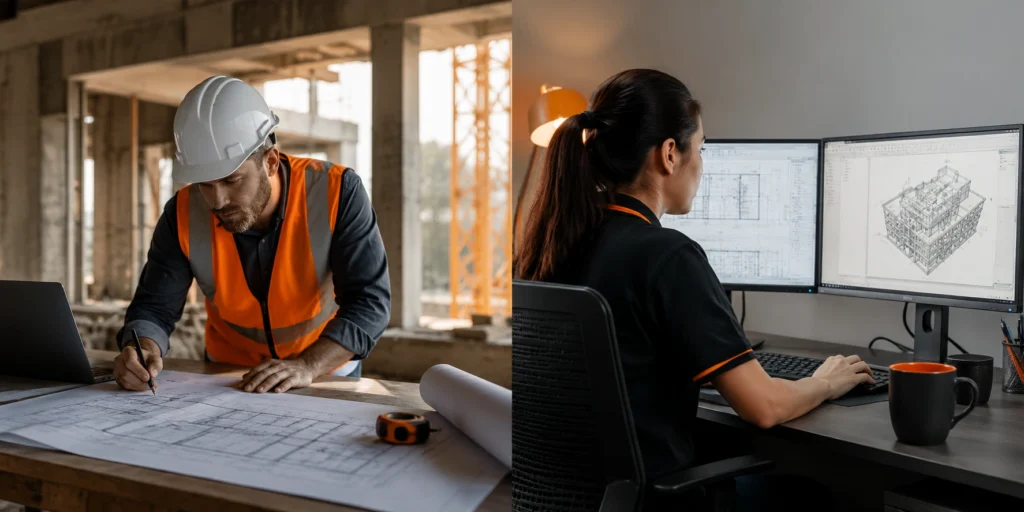
In House vs Outsourced Takeoffs: A Direct Comparison
| Factor | Takeoffs in house | Takeoffs outsourced |
| Cost | Part of a fixed estimator salary | Variable, paid per takeoff or by the hour |
| Capacity | Limited to one estimator’s hours | Scales up during busy bid periods |
| Bid throughput | Sequential, one bid measured at a time | Parallel, measurement runs alongside pricing |
| Project feel | Measurer gains knowledge that aids pricing | Requires a clear handoff to preserve context |
| Quality control | Internal review, familiar standards | Needs a defined review step on return |
| Best fit | Steady, moderate volume, one unburdened estimator | High or seasonal volume, estimator over capacity |
Quality Control Is the Real Concern, and It Is Solvable
The objection that stops most contractors is accuracy. A missed wall or a misread finish schedule in an outsourced takeoff flows straight into the bid, and a bid built on a flawed quantity is wrong before pricing even begins. The concern is legitimate. It is also entirely manageable, and the same discipline applies whether the takeoff is produced in house or outside.
Because a takeoff is verifiable, accuracy is a process question, not a matter of trust. A reliable arrangement has the outside team run its own internal check before sending the takeoff back, and then has the contractor’s estimator spot-check the high-value divisions against the drawings before pricing. Structural, mechanical, and electrical quantities, the divisions where an error costs the most, get the closest look. An error caught at this stage costs a few minutes. The same error caught after the bid is awarded costs margin for the life of the job.
There is one more piece. An outside team needs the contractor’s takeoff standards to produce work the estimator can use without rebuilding it: the naming conventions, the level of breakdown, the way scope is organized. Sharing those at the start, and starting with one smaller project to calibrate, is what turns an outsourced takeoff from a rough draft into a finished input. This is also where the production side of estimating, the takeoffs and bid assembly that a dedicated construction estimating assistant handles, benefits from being a defined role rather than an occasional favor.
The Software Picture Does Not Decide It
Contractors sometimes assume that owning takeoff software is an argument for keeping takeoffs in house, or that not owning it is an argument for outsourcing. Neither holds up. Digital takeoff tools, Bluebeam, PlanSwift, On-Screen Takeoff, STACK, are used on both sides of the decision. An in-house estimator uses them. An outside takeoff team uses them too.
What matters is not who owns a license but whether the takeoff comes back in the format the contractor’s estimator can price from directly. A takeoff produced in the contractor’s own template, with the contractor’s breakdown and naming, is usable immediately. One produced in an unfamiliar structure has to be reorganized, which eats the time the outsourcing was meant to save. The software is a tool both sides already have. The format discipline is the thing that actually determines whether outsourced takeoffs work.
How to Tell Which Side of the Line You Are On
A contractor can usually settle the question by looking honestly at four things.
Count the bids that did not go out
Over the last few busy months, how many invitations were declined or left to expire because no one could get to the takeoff? If the answer is more than a couple, the takeoff is already a constraint on revenue, and that points toward outside support.
Look at when the estimator measures
If the lead estimator is doing takeoffs during normal hours with room to spare, in house is working. If the measuring has moved to evenings and weekends, capacity is already exceeded and the after-hours work is hiding the problem.
Check how steady the volume is
Steady, predictable bid volume favors a fixed in-house arrangement. Volume that swings hard with the season favors capacity that can flex, because a fixed estimator is either underused in the quiet months or overwhelmed in the busy ones.
Confirm the standards are written down
Outsourcing takeoffs only works if the contractor can hand an outside team a clear picture of how takeoffs should be organized. If that has never been documented, it is worth doing regardless of the decision, and it should be done before any takeoff work goes outside.
These four rarely all point the same way, and they do not have to. The pattern across them is usually clear enough to make the call, and for many contractors the honest answer is a hybrid: in-house measuring for the complex or unusual projects where the measurer’s feel for the job matters most, outsourced takeoffs for the steady volume that simply needs to get measured and moved.
How VCA Handles Outsourced Takeoffs
Virtual Construction Assistants (VCA) provides takeoff support for contractors who have decided the measuring work belongs outside the in-house queue. A construction virtual assistant trained in takeoffs works in the contractor’s own takeoff software and templates, produces the quantity takeoff in the contractor’s format, and runs an internal check before the work comes back. The contractor’s estimator reviews it, prices it, and owns the bid. The measurement is delegated. The judgment is not.
Bringing in a construction estimator remote assistant for takeoff work is structured to flex with the bid calendar, which is what suits it to the contractors this decision applies to: high or seasonal volume, an estimator who has run out of hours, or a company that wants to bid more without committing to a fixed hire before the volume proves out. The takeoffs scale up when bidding peaks and the contractor is not carrying that cost through the slow stretch.
Frequently Asked Questions
Should a contractor outsource takeoff services?
A contractor should outsource takeoffs when bid volume has outgrown what the in-house estimator can measure, shown by declined invitations or takeoffs being done after hours. Outsourcing works well for high or seasonal volume. A contractor with steady, moderate volume and an unburdened estimator is usually better off keeping takeoffs in house.
Are outsourced takeoffs accurate?
Yes, when a review process is in place. A takeoff is verifiable work that can be checked against the drawings. A reliable arrangement has the outside team run an internal check, then has the contractor’s estimator spot-check the high-value divisions before pricing. Accuracy comes from the review discipline, which applies equally to in-house takeoffs.
How much does it cost to outsource a construction takeoff?
Outsourced takeoffs are usually priced per takeoff or by the hour, and the fee scales with the size and number of divisions in the project. The useful comparison is against the fixed cost of an in-house estimator’s time. For contractors with uneven bid volume, paying per takeoff is generally lower in total than carrying that capacity year-round.
Do I need takeoff software to outsource takeoffs?
No. The outside takeoff team uses digital takeoff tools such as Bluebeam, PlanSwift, On-Screen Takeoff, or STACK on their side. What matters is that the finished takeoff comes back in the contractor’s own format and breakdown so the estimator can price from it directly without reorganizing it.
What is the difference between outsourcing takeoffs and outsourcing estimating?
Outsourcing takeoffs delegates only the quantity measurement. Outsourcing estimating can cover a wider span of bid production, takeoffs plus bid package assembly and subcontractor tracking. In both cases, pricing, markup, and the final number stay with the contractor. Takeoffs are simply the largest and most verifiable piece to start with.
Can outsourced and in-house takeoffs be used together?
Yes, and many contractors do exactly that. A common hybrid keeps in-house measuring for complex or unusual projects, where the measurer’s feel for the job aids pricing, and uses outsourced takeoffs for the steady volume that simply needs to be measured and moved through the bid process.
Match the Takeoff to the Capacity You Actually Have
The takeoff is where the bid period quietly gets eaten. For a contractor whose volume fits one estimator, measuring in house keeps useful project knowledge close to the pricing. For a contractor whose bidding has outgrown that, sending takeoffs outside is the most direct way to bid more without burning out the estimator or adding a fixed hire too soon. The decision is not about which option is better in the abstract. It is about which one matches the volume on the calendar.
Virtual Construction Assistants (VCA) gives contractors takeoff capacity that flexes with the bid calendar, produced in the contractor’s own software and format, with the pricing left entirely in-house. For a contractor sorting out where the takeoff line should fall, the broader case for outsourced construction estimating puts the takeoff decision in the context of the whole bidding operation.


