
If you have landed on this page, you are probably one of two people. You might be someone working in construction administration, bookkeeping, or project coordination who is tired of the commute and curious whether your skills translate to remote work. Or you might be a virtual assistant who has noticed that construction clients pay better than the average e-commerce gig and wants to know how to break into that market.
Either way, this guide is for you. We have spent years inside the construction staffing world at Virtual Construction Assistants (VCA), and what follows is an honest look at how this career path actually works, what it takes to succeed, and how to position yourself to land your first role.
No fluff. No “make six figures from your laptop in 30 days” promises. Just a practical roadmap.
What a Construction Virtual Assistant Really Does
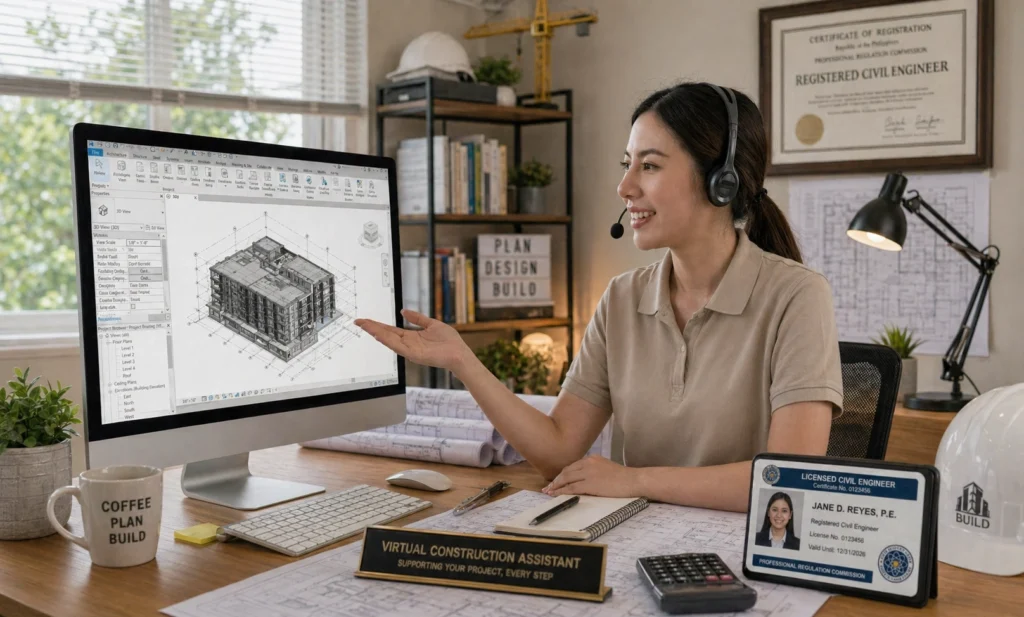
A construction virtual assistant (CVA) is a remote professional who provides specialized administrative, financial, or project support to construction companies. The role exists because construction firms have a unique problem: they need skilled office staff who understand the industry, but they cannot always justify the cost of full-time, in-house employees, especially in expensive labor markets.
That is where remote construction professionals come in. A construction VA can sit anywhere in the world and handle tasks like RFI tracking, submittal coordination, AIA billing, lien waiver management, takeoffs, and project scheduling for a contractor based in New York, Los Angeles, Sydney, or Toronto.
The work is real and the responsibility is significant. You are not answering generic emails or formatting spreadsheets for a vague client. You are helping keep multi-million dollar projects on schedule, ensuring subcontractors get paid on time, and making sure the project manager has what they need to walk into a Monday morning meeting prepared.
This is why construction-specific knowledge matters so much in this field, and why generalist VAs often struggle to compete with someone who actually understands the difference between a Schedule of Values and a Pay Application.
Why Demand for Construction VAs Is Climbing in 2026
Three forces are driving the growth of this niche, and understanding them will help you see why now is a good time to get in.
The labor shortage is not slowing down. The Associated General Contractors of America has reported persistent labor gaps for years, and the shortage extends to office staff just as much as to field workers. Contractors who used to find qualified estimators or project coordinators in their local market are now waiting months to fill those seats. Remote talent fills that gap faster.
Software has made remote work practical. Platforms like Procore, Buildertrend, Bluebeam Revu, CoConstruct, and Sage 100 Contractor are cloud-based and built for distributed teams. A construction VA in the Philippines can update a project log in Procore that the superintendent in Houston sees on their tablet thirty seconds later. The infrastructure is there.
Margins are tighter than ever. Material costs, insurance premiums, and wage pressure have squeezed contractor margins. Hiring a remote professional who can handle the same workload at a lower total cost is no longer a fringe idea. It is becoming standard practice for small and mid-sized firms that want to stay competitive.
For someone considering this career path, this means the work is there. The challenge is positioning yourself correctly to capture it.
The Different Types of Construction Virtual Assistant Roles
One mistake new entrants make is treating “construction VA” as a single job. It is not. The field is segmented into specialties, and the path to success usually involves picking one or two and going deep.
Project Management Support
This is the largest and most common category. Roles include construction coordinators, assistant project managers, RFI coordinators, and submittal coordinators. The day-to-day work involves chasing down information, tracking deadlines, organizing project documents, and being the central nervous system for a job site you have never physically visited.
If you have worked in a construction office before, this is probably your most natural entry point.
Construction Finance and Bookkeeping
Construction accounting is its own world. Job costing, retainage, AIA billing, certified payroll, and percentage-of-completion accounting are not things a generalist bookkeeper typically handles well. A construction virtual assistant who specializes here, especially one with QuickBooks Contractor or Sage experience, can command higher rates and tends to have very stable, long-term client relationships.
Estimating and Preconstruction
Estimating support involves preparing bid packages, performing on-screen takeoffs (OST), researching material pricing, and helping the lead estimator hit deadlines during a busy bid season. This role rewards accuracy and attention to detail, and demand spikes during certain times of the year. Familiarity with PlanSwift, Bluebeam, or STACK is a real differentiator.
Shop Drawing and CAD Support
If you have a drafting background or AutoCAD skills, there is a specific niche for shop drawing technicians who support fabricators, steel contractors, and millwork firms remotely. This is a more technical role that pays accordingly.
Construction Marketing and CRM
Many contractors are realizing they need a real online presence and a structured sales pipeline. Construction VAs who can manage social media, write content for a construction audience, run digital campaigns, or maintain a CRM like HubSpot or Salesforce are in growing demand.
Specialized Trade Support
General contractors are not the only ones hiring. Plumbing companies, electrical contractors, HVAC firms, roofing businesses, and landscaping companies all need administrative support tailored to their trade. The vocabulary and workflows differ slightly between trades, but the core skills transfer.
Skills That Actually Matter (And Skills That Are Overrated)
Plenty of online guides will tell you that you need to be a master of every construction software on the market and have a degree in construction management. The reality is more nuanced.
What genuinely matters
Construction literacy is the single most important asset. You should be able to read a basic set of plans, understand the typical project lifecycle, and know what a submittal, punch list, change order, and RFI actually are. You do not need to be an engineer, but you need to speak the language fluently.
Software fluency in two or three core platforms beats surface-level familiarity with ten. Pick the tools your target clients use most and get genuinely competent.
Written communication is the skill most underrated by people entering this field. Construction professionals are busy and direct. Long, rambling emails frustrate them. Clear, concise, well-organized written updates are appreciated and remembered.
Self-directed problem solving separates good construction VAs from great ones. Your client does not have time to micromanage you. The ability to recognize what needs to be done, do it, and report back is what builds long-term client relationships.
What is overrated
Having every certification under the sun. One or two relevant credentials matter. Stacking certifications without practical experience does not move the needle.
A formal construction management degree. It helps, but it is not required. Plenty of successful construction VAs came from in-office administrative roles in construction firms and worked their way up through hands-on experience.
Being a “jack of all trades.” The construction virtual assistant market rewards specialists. Being decent at everything makes you replaceable. Being excellent at one thing makes you valuable.

A Realistic Step-by-Step Path to Your First Role
Step 1: Audit your existing skills honestly
Make two lists. The first is everything you already know about construction, project management, accounting, or relevant software. The second is everything you would need to learn to handle a typical construction VA role end-to-end. Be honest. The gap between those two lists is your roadmap.
Step 2: Pick a specialty
Do not try to be everything to everyone. Look at the categories above and pick the one that aligns best with your existing experience and interests. If you have bookkeeping experience, lean into construction finance. If you are a strong organizer, project coordination is a natural fit. If you have drafting skills, go after shop drawing roles.
Step 3: Close your software gaps
Identify the two or three platforms most relevant to your chosen specialty and get genuinely proficient. Procore offers a free certification program. QuickBooks has online training. Bluebeam, Buildertrend, and most major platforms have free trial periods or training resources. Spend a few weekends here and you will be ahead of most of the competition.
Step 4: Build a focused portfolio
Even without paid client experience, you can create sample work that demonstrates capability. Build a sample project tracker in Procore. Set up a mock job costing report in QuickBooks. Create a sample RFI log. These artifacts give potential employers something concrete to evaluate.
Step 5: Apply through specialized firms first
This is where most people make their job search ten times harder than it needs to be. Cold-applying to random construction companies on Indeed is slow and frustrating because most contractors do not know how to evaluate or onboard a remote VA. They want someone who has already been vetted.
Specialized staffing firms like Virtual Construction Assistants (VCA) exist precisely to bridge this gap. They have a roster of construction companies actively looking to hire, and they handle the matching, training support, and ongoing relationship management. For a new construction virtual assistant, going through a firm is usually the fastest path to a steady role.
Step 6: Treat your first role like a launchpad
Your first construction VA role is rarely your dream role, and that is fine. The goal is to build a track record, accumulate references, and learn the rhythms of remote construction work. Within twelve to eighteen months, you will have the experience and confidence to take on bigger clients, raise your rates, or specialize further.
What You Can Expect to Earn
Compensation in this field varies widely based on specialty, experience, geography, and engagement model. Entry-level administrative roles tend to start in the lower range, while specialized roles like construction estimators, financial analysts, or CAD technicians earn meaningfully more.
Working through a staffing firm typically provides more consistent income than freelancing on your own, especially in the first year. The trade-off is that the firm takes a margin in exchange for handling client acquisition, contract management, and quality assurance. For most new construction VAs, that trade-off is worthwhile.
As you build experience and reputation, options expand. Some construction VAs eventually transition to full-time remote employee roles with a single contractor. Others build their own small agencies. Both paths are viable.
Common Mistakes to Avoid
Going too broad too fast. Trying to position yourself as a generalist construction VA who can do everything makes it hard for clients to know what to hire you for. Specialize.
Underpricing yourself permanently. It is fine to take a lower rate on your first role to build experience, but raise your rates as you gain credibility. Construction clients respect people who know their value.
Ghosting on responsiveness. Construction is fast-paced. A construction VA who takes eight hours to respond to a simple message will not last long. Set clear availability windows and stick to them.
Pretending to know things you do not. Construction professionals can smell this from a mile away. If you do not know what something is, ask. They would rather train you on terminology than catch you faking it.
Frequently Asked Questions
Do I need to live in the United States to work as a construction virtual assistant?
No. Many construction VAs work from the Philippines, Latin America, Eastern Europe, and other regions while supporting US, Canadian, and Australian construction firms. Strong English communication and reliable internet are the main requirements.
How long does it take to become qualified as a construction virtual assistant?
If you already have construction office experience, you can often start applying right away. If you are coming from a different industry, expect three to six months of focused learning before you are ready for your first role.
What is the most useful certification for a construction VA?
It depends on your specialty. For project management roles, Procore certification is widely recognized. For finance roles, QuickBooks ProAdvisor certification stands out. For estimating, Bluebeam certification adds credibility. None are mandatory, but they help.
Can I work as a construction VA part-time while keeping another job?
Yes, especially if you start on a contract or hourly basis. Many construction VAs begin part-time, build a client base, and transition to full-time work once the income justifies it.
What is the difference between a construction VA and an in-house administrative assistant?
The work overlaps significantly, but the construction VA model is remote, often hourly or contract-based, and usually delivered through a staffing firm or independent contracting arrangement. The skill set is the same. The structure is different.
Will AI replace construction virtual assistants?
Some routine tasks like data entry and basic scheduling will increasingly be automated, which is true across many fields. The roles that involve judgment, communication, and coordination, which describes most of construction VA work, are not going away. If anything, construction VAs who learn to use AI tools effectively will be more valuable, not less.
Does a construction virtual assistant need their own software licenses?
Usually not. The construction firm or staffing agency typically provides access to the platforms you will need. You will need a reliable computer, a good internet connection, and a quiet work environment.
How do I get started with Virtual Construction Assistants (VCA) specifically?
We accepts applications from qualified candidates through our Be a VA career page. The process involves an application, skills assessment, and interview. If matched with a client, you receive support throughout onboarding and the engagement.
Is being a construction VA a sustainable long-term career or just a stopgap?
It is a real career. Many people who entered this field five or ten years ago are now leading remote teams, running their own agencies, or have transitioned into senior roles with construction firms. The industry is here to stay, and remote support has become a permanent fixture.
Can I become a construction virtual assistant with no construction background at all?
You can still enter the field, but be honest with yourself that the path is longer. Start with foundational construction knowledge through free online resources, learn one or two key software platforms, and consider taking on lower-paid initial work to build credibility. Pair that with strong general administrative or accounting skills, and you can build a viable path within a year.
Final Thoughts
Becoming a construction virtual assistant is not a get-rich-quick path or a passive income scheme. It is a real career that rewards real skills, and the people who succeed are the ones who treat it that way.
The construction industry is opening up to remote support faster than most people realize, and the demand for qualified, construction-literate virtual professionals is going to keep growing. If you are willing to put in the work to specialize, build credibility, and serve clients well, this is one of the more accessible and rewarding remote career paths available right now.
If you are ready to take the next step, the team at Virtual Construction Assistants (VCA) is one of the best places to start. We work exclusively in this niche, and we know what construction firms need from a remote support professional. Reach out, and let us see if there is a fit.