
Shop drawings and submittals are related but not the same thing. A submittal is the broader category. A shop drawing is one specific type of submittal.
The confusion between the two is common, and it causes real problems on construction projects. When a PM asks a subcontractor for a submittal and the sub sends a product data sheet when a shop drawing is required, the review cycle stalls. When a document controller logs a shop drawing under the wrong submittal type, the approval trail breaks down.
This article explains exactly what each term means, how they differ, who prepares them, how they move through the review process, and how to track both without letting one fall through the cracks.
What Is a Submittal in Construction?
A submittal is any document, sample, or product information that a contractor or subcontractor provides to the architect or engineer for review and approval before construction proceeds or materials are installed.
Submittals are required by the project specifications. Each specification section that involves a material, system, or piece of equipment typically lists what submittals are required and when they must be provided.
Common submittal types include:
- Shop drawings
- Product data sheets and cut sheets
- Material samples
- Test reports and certifications
- Warranties and maintenance manuals
- Mock-ups
- Closeout documentation
The submittal process exists so the design team can verify that what the contractor intends to use or build matches what was designed and specified. It is a quality control checkpoint, not a formality.
What Is a Shop Drawing?
A shop drawing is a detailed technical drawing produced by a subcontractor, fabricator, or supplier that shows exactly how a specific component will be manufactured, fabricated, or installed.
Shop drawings translate the design intent shown on the architect’s or engineer’s drawings into fabrication-ready instructions. They are produced by the people who will actually build or manufacture the component, not by the design team.
Examples of shop drawings include:
- Structural steel connection details produced by the steel fabricator
- Curtain wall system layouts produced by the glazing contractor
- Mechanical duct routing drawings produced by the sheet metal contractor
- Precast concrete panel drawings produced by the precast manufacturer
- Millwork shop drawings produced by the casework fabricator
- Rebar placement drawings produced by the reinforcing contractor
Shop drawings are one of the most technically detailed submittal types. They require careful review by the structural engineer, architect, or MEP engineer because an error in a shop drawing can lead to fabrication mistakes that are expensive to correct in the field.
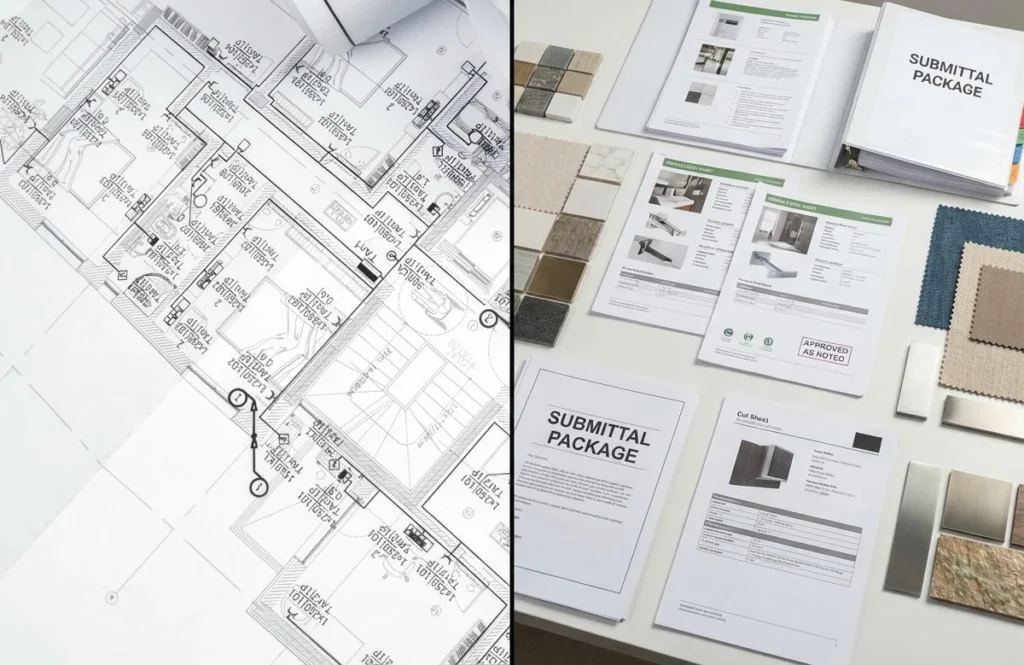
Shop Drawings vs Submittals: Side-by-Side Comparison
Here is a direct comparison of the two:
| Submittal (General) | Shop Drawing | |
| What it is | Any document or sample requiring A/E review | A fabrication-level drawing showing how something is built |
| Who prepares it | Subcontractor, supplier, or fabricator | Subcontractor, fabricator, or manufacturer |
| Format | Drawings, data sheets, samples, reports, warranties | Technical drawings, dimensions, details, schedules |
| Level of detail | Varies by type | High — fabrication and installation-ready |
| Review responsibility | Architect, engineer, or owner depending on type | Structural engineer, architect, or MEP engineer |
| Purpose | Confirm compliance with specs and design intent | Verify fabrication details before manufacturing begins |
| When required | Specified per section in the project specs | Required for fabricated components and custom systems |
| Logged in submittal log? | Yes | Yes — as one submittal type |
How the Review Process Works for Each
Both shop drawings and other submittal types move through the same general review cycle, but the review complexity and turnaround time differ.
Submittal review process (general)
- Subcontractor or supplier prepares the submittal based on spec requirements
- Sub submits to the general contractor for initial review
- GC reviews for coordination with other trades and confirms the submittal matches what was specified
- GC transmits to the architect or engineer for formal review
- A/E reviews within the contractual review period (typically 10 to 21 days)
- A/E returns with one of four actions: Approved, Approved as Noted, Revise and Resubmit, or Rejected
- GC logs the return action and notifies the sub
- If Revise and Resubmit, the cycle repeats
Shop drawing review — additional considerations
Shop drawings go through the same cycle, but the review is more technically demanding. The engineer or architect must verify:
- Dimensions and tolerances match the design documents
- Connection details, load paths, or system configurations are structurally sound
- The fabrication approach is constructible and does not conflict with adjacent work
- Any deviations from the contract documents are flagged and addressed
This is why shop drawings often take longer to review and why the Revise and Resubmit action is more common for shop drawings than for product data submittals. A single dimension error or a missing connection detail can send a structural steel shop drawing back for a full revision.
Who Prepares Shop Drawings vs Other Submittals
Understanding who is responsible for each submittal type helps prevent gaps in the process.
Shop drawings
Shop drawings are prepared by:
- Steel fabricators for structural steel and miscellaneous metals
- Glazing contractors for curtain wall and storefront systems
- Mechanical, electrical, and plumbing subcontractors for duct layouts, equipment, and conduit routing
- Precast manufacturers for precast concrete panels and components
- Casework and millwork fabricators for custom cabinetry and built-ins
- Concrete subcontractors for rebar placement drawings
The fabricator or subcontractor is responsible for the technical accuracy of their shop drawings. The architect or engineer reviews for design compliance but does not take responsibility for the fabricator’s means and methods.
Product data and cut sheets
Product data submittals are typically prepared by the subcontractor or supplier and pulled directly from manufacturer documentation. The sub selects the product, assembles the relevant data sheets, and marks the specific model, configuration, or finish being provided.
Samples
Material samples — such as flooring, paint chips, tile, or roofing membrane sections — are prepared and submitted by the subcontractor or supplier. The architect reviews and either approves the sample or requests an alternative.
How Mixing Up Shop Drawings and Submittals Causes Project Delays
The confusion between shop drawings and submittals is not just a terminology problem. It creates real delays when it shows up in project workflows.
- Requesting the wrong submittal type: A PM tells a steel fabricator to “send the submittal” when what is actually needed is a stamped shop drawing. The fabricator sends a product data sheet instead. The review cycle starts over.
- Logging shop drawings under the wrong category: A document controller logs a shop drawing as product data in the submittal log. The log no longer accurately reflects what has and has not been reviewed. At closeout, the team cannot confirm which fabrication drawings were formally approved.
- Approving a product data sheet when a shop drawing was required: An architect approves a product data submittal without realizing the spec required a detailed shop drawing for that component. The fabricator proceeds without a reviewed shop drawing. The field installation reveals a coordination conflict that was never caught.
- Treating shop drawings as a formality: A sub begins fabrication before the shop drawing is formally approved. The A/E returns a Revise and Resubmit action after fabrication has already started. The cost of the revision falls on the sub and creates a schedule delay.
- Failing to track revision cycles separately: A shop drawing goes through three revision cycles but is tracked as a single entry in the log. There is no clear record of what changed between revisions. If a dispute arises later, the team cannot reconstruct the approval history.
Best Practices for Managing Shop Drawings and Submittals Together
- Categorize submittals correctly from the start. When building the submittal log, distinguish shop drawings from product data, samples, and test reports. Each type gets its own row and its own tracking fields.
- Do not allow fabrication to begin before shop drawings are approved. Build this requirement into subcontract language and reinforce it during the pre-construction meeting.
- Set a separate review schedule for shop drawings. Because shop drawings take longer to review and are more likely to require revisions, track them with tighter internal deadlines than simpler submittal types.
- Log every revision cycle as a separate entry. When a shop drawing comes back as Revise and Resubmit, create a new log entry for the resubmittal. Link it to the original. This preserves the full approval history.
- Use consistent naming conventions. Shop drawings should be named and numbered in a way that identifies the spec section, the trade, and the revision number. Inconsistent file naming creates confusion when reviewing transmittals and tracking approvals.
- Communicate review status to the fabricator promptly. Delays in notifying the fabricator of an approved or revised shop drawing extend lead times. The faster the fabricator gets the approved drawing, the sooner fabrication can begin.

How Construction Virtual Assistants Support Submittal and Shop Drawing Management
Managing submittals and shop drawings is largely an administrative workflow. The review decisions belong to the design team and the GC’s technical staff. But the daily work of logging, tracking, routing, following up, and organizing — that is where projects fall behind.
Once the submittal schedule and workflow are established, a construction VA from Virtual Construction Assistants (VCA) can take ownership of the recurring coordination and documentation tasks that keep the process moving.
What a Construction VA handles in submittal and shop drawing management:
- Setting up and maintaining the submittal log with separate tracking for shop drawings, product data, samples, and other submittal types
- Logging incoming submittals from subcontractors and suppliers and confirming that the correct submittal type was provided
- Preparing and logging transmittals each time a submittal moves between parties
- Tracking A/E review deadlines and flagging submittals that are approaching or past the contractual review period
- Creating separate revision cycle entries when a Revise and Resubmit action is returned
- Notifying subcontractors and fabricators when approved shop drawings are returned so fabrication can proceed
- Preparing weekly submittal status reports for the PM, superintendent, and project engineer
- Supporting closeout by verifying that every submittal type — including all shop drawing revisions — has a closed and approved status
Construction virtual assistant works within the project management platforms the team already uses, including Procore, Autodesk Construction Cloud, and Excel-based tracking systems. The goal is to make sure nothing slips through on a busy review cycle — whether that is a structural steel shop drawing waiting for the engineer or a product data submittal that needs to clear before procurement can move forward.
Frequently Asked Questions
Is a shop drawing the same as a submittal?
No. A shop drawing is one specific type of submittal. Submittals include shop drawings, product data sheets, samples, test reports, warranties, and other documents. Every shop drawing is a submittal, but not every submittal is a shop drawing.
Who reviews shop drawings on a construction project?
Shop drawings are reviewed by the architect, structural engineer, or MEP engineer depending on the trade. The general contractor reviews first to check for coordination conflicts and conformance with the contract documents before forwarding to the design team.
What does ‘Approved as Noted’ mean on a shop drawing?
Approved as Noted means the shop drawing is approved subject to the comments or markups made by the reviewer. The contractor must incorporate those notes into the work. If the notes are significant, a resubmittal may be required before fabrication begins.
How long does shop drawing review typically take?
The contractual review period is typically specified in the General Conditions and commonly ranges from 10 to 21 calendar days. Complex shop drawings, such as structural steel or curtain wall systems, may take longer, especially if revisions are required.
Can fabrication start before a shop drawing is approved?
Fabricating before shop drawing approval is a significant risk. If the drawing comes back with a Revise and Resubmit action, any material already fabricated may need to be reworked or scrapped at the subcontractor’s expense. Most subcontracts explicitly prohibit fabrication before formal approval.
How should shop drawings be filed and organized?
Shop drawings should be filed by spec section, trade, and revision number. Each revision cycle should be kept as a separate file so the approval history is traceable. The submittal log should cross-reference the file location so any team member can find the current approved drawing without searching through email.
Need Help Tracking Submittals and Shop Drawings Across a Busy Project?
Keeping shop drawings and submittals organized through multiple revision cycles is one of the most time-consuming admin tasks on a construction project. If your team is stretched, a virtual assistant from Virtual Construction Assistants (VCA) can own the daily tracking, routing, and follow-up so approvals stay on schedule.
Contact Virtual Construction Assistants (VCA) to learn how we support construction document control and submittal management for general contractors, subcontractors, and construction management firms.