
Quality control in architectural outsourcing is the system of checks, reviews, and feedback loops that catch errors before they reach a client, consultant, or contractor. It does not rely on the outsourced team being perfect. It relies on a defined process running on every deliverable, with clear ownership on both sides of the firm boundary. When QC is built in, outsourcing produces work that meets or exceeds in-house quality. When it is missing, the firm pays for it later in rework, damaged client trust, or liability exposure.
Most outsourcing engagements that fail on quality do not fail because of skill. They fail because nobody defined who checks what, when, against which standard, and what happens when something is wrong. This article walks through how a working QC system is structured, who owns each step, and the recurring mistakes that cause architectural QC to break down.
Why Outsourced QC Needs Its Own System
QC inside a single firm runs on a mix of habit, hallway conversation, and a senior person glancing over a junior person’s shoulder. None of that survives the firm boundary. When production moves outside the firm, every quality check that was informal needs to become explicit.
Three things change. The reviewer cannot tap the modeler on the shoulder to clarify a question. The standards the modeler works from need to be written, not assumed. And the feedback loop has to be documented so corrections carry forward instead of getting lost in chat.
These three changes mean QC has to be designed, not improvised. Firms that get this right build their QC system during the structured 30-day onboarding plan, not after problems show up. Firms that wait usually find themselves rebuilding trust at the same time as rebuilding the process.
The Two Layers of Architectural QC
A working QC system runs on two layers. Both are necessary.
Layer 1: QC inside the outsourced team
Before any deliverable leaves the outsourced team, it gets checked against the firm’s standards by a reviewer on that team. This is the production-side check. It catches the issues that come from the modeler being human: a wrong layer, a missing tag, a sheet number that does not follow convention, a schedule that did not synchronize after the last revision.
Internal QC is what separates a serious provider from one that just produces volume. A team without it sends every error to the firm’s reviewer, which inflates QA workload and erodes trust quickly.
Layer 2: QC inside the firm
Once the deliverable arrives back at the firm, it gets checked by the firm’s internal reviewer before it goes anywhere downstream: client, consultant, contractor, or permit. This is the responsibility-side check. The architect of record stamps and seals the work, and the firm’s reviewer is the last line of defense before the firm’s name is on it.
Both layers run on the same standards reference. They are not redundant. The outsourced layer catches production errors. The firm layer catches anything the outsourced team could not have known: project context, recent design decisions, or coordination issues with consultants the outsourced team is not in contact with.
What Actually Gets Checked
QC is a checklist of specific items, broken down by deliverable type. The list differs for drafting, modeling, and BIM coordination work, but the structure is the same.
For outsourced drafting work, the QC checklist usually covers:
- Layer assignments and line weights against the firm’s standard
- Sheet naming, sheet numbering, and title block population
- Cross-references between plans, sections, and details
- Tagging, dimensioning, and annotation conventions
- Revision clouds, revision schedules, and addenda tracking
- Detail callouts and consistency between sheets
For outsourced Revit modeling work, the QC checklist shifts to model-specific items:
- Family naming, family hygiene, and parameter conventions
- View templates applied correctly across views
- Workset assignments and central file integrity
- Schedule synchronization with model parameters
- Linked file management and project base point alignment
- Orphan elements, broken links, and warning count
For outsourced BIM coordination, the QC checklist expands further to coordination items:
- LOD compliance per element category against the BIM execution plan
- Federation accuracy across discipline models
- Clash report filtering, prioritization, and resolution tracking
- Coordination meeting documentation and clash closure rates
- Shared coordinates and project base point across federated models
- Quantity takeoff accuracy against the model
Each firm should write its own checklists in language the outsourced team can use without ambiguity. A checklist that says check sheet quality is useless. One that says verify all sheet numbers follow A-101 through A-999 with no skipped numbers is usable.
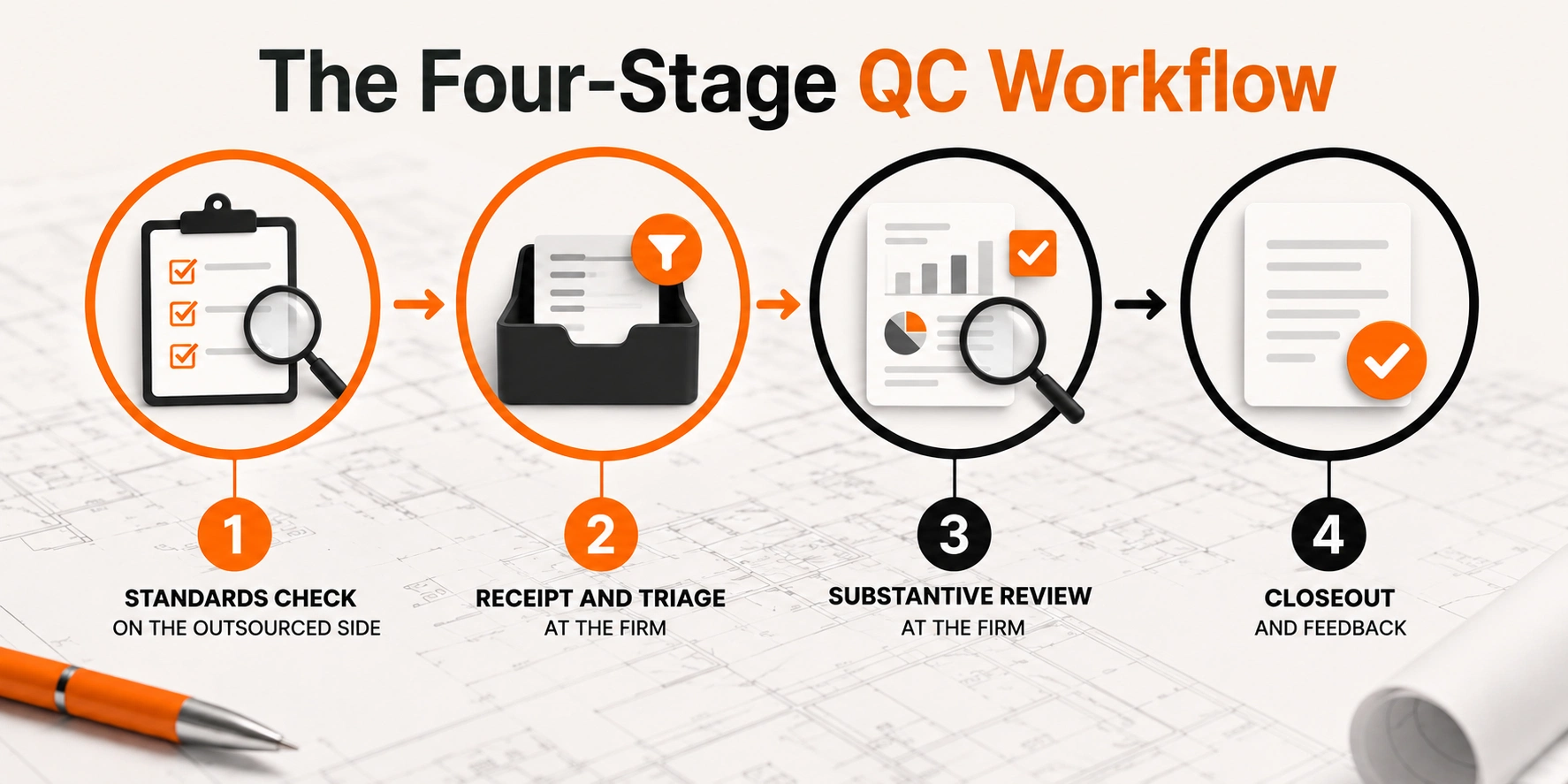
The Four-Stage QC Workflow
A working QC system runs every deliverable through four stages, in order. Skipping any stage is what causes problems to slip through.
Stage 1: Standards check on the outsourced side
A reviewer on the outsourced team checks the deliverable against documented standards before it is sent. This catches layer errors, naming inconsistencies, missing tags, and broken cross-references. Anything that fails goes back to the modeler before the firm sees it.
Stage 2: Receipt and triage at the firm
When the deliverable arrives, the firm’s internal point of contact logs it, confirms it is the right deliverable on the right project, and routes it to the correct reviewer. This prevents it from sitting unread while the project clock runs.
Stage 3: Substantive review at the firm
The firm’s internal reviewer checks the deliverable against project context: recent design decisions, consultant input, code-level items, and anything the outsourced team would not have known. This layer protects the firm’s professional responsibility. Findings get documented and routed back.
Stage 4: Closeout and feedback
Once corrections are made and verified, the deliverable is approved for issue. Findings get logged to inform future work. Repeat issues become updates to the standards reference.
QC Workflow at a Glance
| Stage | Owner | What gets checked | Output |
| 1. Standards check | Outsourced team reviewer | Standards compliance, naming, tagging, layer use | Deliverable cleared for handoff |
| 2. Receipt and triage | Firm’s internal point of contact | Right deliverable, right project, right reviewer | Deliverable routed for review |
| 3. Substantive review | Firm’s internal reviewer | Project context, recent decisions, code items, consultant alignment | Findings list returned to outsourced team |
| 4. Closeout and feedback | Internal point of contact and outsourced team | Verification of corrections and pattern logging | Approved deliverable, updated standards, lessons captured |
Common QC Breakdowns and How to Prevent Them
QC systems do not fail loudly. They erode quietly. Most of the time, the breakdown is one of these patterns.
No documented standards to check against
If standards have not been written down, the outsourced QC has nothing to check against, and the firm’s QC becomes a personal-preference exercise. Both layers fail at once. The fix is documenting standards before the engagement begins.
Skipping the outsourced-side check
When the outsourced team sends raw work straight to the firm without internal review, the firm’s reviewer becomes the first line of defense. That inflates QA workload, slows turnaround, and signals that the outsourced team is not investing in its own quality. A serious partner runs internal QC as a non-negotiable.
No clear ownership at the firm
If three people inside the firm review different deliverables based on who is available that day, comments contradict each other and corrections do not carry forward. One named internal reviewer per project, with a clear backup, prevents this.
Findings logged in chat instead of a tracker
QC findings sent through chat tend to disappear. The same issue surfaces three deliverables later because nobody recorded the original correction. A simple tracker, a shared sheet or punchlist tool, prevents the same finding from being raised twice.
No closeout step
Firms that mark the deliverable approved and never log what was found miss the chance to improve. Repeat issues never become standards updates. Lessons stay in one reviewer’s head. Adding even a one-line closeout note to each finding prevents this drift.
Treating QC as a stage, not a habit
Some firms run QC only at issue milestones, then are surprised when late-stage problems are expensive to fix. QC at the deliverable level, baked into the broader construction document control workflow alongside revision tracking, catches issues at a fraction of the late-stage cost.
Building a Working QC System
A working QC system is built from a small number of components. Each one is simple. The discipline is in running them consistently.
- Documented standards reference. Layer naming, sheet naming, family naming, view templates, workset structure, BEP for BIM work. One document everyone can refer to.
- Deliverable-specific QC checklists. Drafting checklist, modeling checklist, BIM coordination checklist. Specific items, not vague checks.
- Named owners on both sides. One reviewer on the outsourced team and one internal reviewer at the firm, with backups documented.
- A findings tracker. A shared, searchable record of every finding raised, who owns the correction, and when it was resolved.
- A closeout step. Every finding gets a one-line note on resolution and any standards update that came out of it.
- A regular pattern review. Monthly or per-milestone, look at the findings tracker for repeat issues. Repeat issues become standards updates.
- Connection to the broader workflow. QC findings flow into revision logs, version control, and document control, not into a parallel paper trail nobody reads.
Audit Trails, Version Control, and the Paper Side of QC
QC also produces a record. Every finding, correction, and approval is part of the project’s documented history. That record supports the firm’s professional responsibility, informs future projects, and protects the firm if a deliverable is questioned downstream.
A defensible audit trail tracks who reviewed what, when, against which version, and what changed in response. This overlaps with the discipline of securing drawings and client data in outsourced engagements, because the same controls that protect data integrity, version control, access logs, and file ownership, also support the audit side of QC.
Practically, the firm should be able to answer the following at any point in the project lifecycle:
- Which version of the deliverable did the outsourced team submit, and when?
- Who reviewed it on the outsourced side, and what did they check?
- Who reviewed it on the firm side, and what did they find?
- What corrections were made, and against which version were they verified?
- Which version was approved for issue, and to whom was it issued?
If the firm cannot answer any of these for a given deliverable, the QC system has a gap. Closing that gap usually means tightening file naming, version tracking, and review documentation, not adding new tools.
How QC Connects to the Broader Outsourcing Strategy
QC is not a standalone activity. It is the operational layer that lets the decision to outsource architectural production hold up under real conditions. Without working QC, every other benefit erodes: senior staff get pulled back into rework, the production capacity advantage disappears, and the relationship becomes transactional.
Firms that get the most out of outsourcing build QC into every workstream: drafting, modeling, BIM coordination, and the administrative workflows around the project. The QC system is what turns outsourcing from a stopgap into a real production capability.

How Virtual Construction Assistants (VCA) Approaches QC
Virtual Construction Assistants (VCA) operates with QC built into the engagement, not bolted on. The outsourced team runs internal standards checks before deliverables are sent, the firm runs project-context review on receipt, and findings flow into a shared tracker both sides can see.
What a construction virtual assistant supporting an architecture firm typically owns on the QC side:
- Internal standards check against the firm’s documented reference
- Pre-handoff verification of layer use, sheet naming, and tagging
- Schedule synchronization and parameter checks for Revit deliverables
- Family hygiene, view template application, and workset integrity for modeling work
- Clash report filtering, prioritization, and tracking for BIM coordination
- Findings log maintenance and version control across the project lifecycle
- Pattern reporting back to the firm for standards updates
The firm’s internal reviewer keeps the substantive review and final approval. The outsourced QC role focuses on production-side discipline, the layer that prevents avoidable findings from reaching the firm’s reviewer.
Frequently Asked Questions
How much time does QC actually add to a deliverable?
Less than firms expect. A well-structured QC pass adds 10 to 20 percent to deliverable time on the outsourced side and a smaller percentage on the firm side. The time saved on rework is consistently larger than the time spent on QC, usually by a wide margin.
Can QC be fully automated?
Parts of it can. Revit warnings, naming convention scripts, and clash detection can be automated. But substantive review, the project-context layer, requires a human who knows the project. Treating automation as a complement to human review works. Treating it as a replacement does not.
Who owns final QC responsibility?
The architect of record, always. The outsourced team is responsible for delivering work that meets standards, but professional responsibility for the issued deliverable stays with the licensed architect. QC supports that responsibility but does not transfer it.
How often should QC findings get reviewed for patterns?
Monthly is the practical minimum on active projects. Per-milestone is better. The goal is to catch repeat issues early enough to update standards before they multiply.
What if the outsourced team and the firm disagree on a finding?
Those disagreements usually point to a gap in the standards reference, not a personality issue. Updating the reference to clarify the disputed item resolves the immediate finding and prevents the same disagreement on the next deliverable.
Does QC apply to administrative work too?
Yes. Transmittals, RFI logs, submittal tracking, revision logs, and other administrative deliverables benefit from the same checklist-and-review structure. Many late-stage project problems trace back to administrative QC gaps, not drawing errors.
Build QC In, Not On
Quality control in architectural outsourcing is not a final-stage gate. It is a system that runs on every deliverable, with clear ownership on both sides of the firm boundary. Firms that build QC in from the start get production capacity that scales without sacrificing quality. Firms that try to add it after problems show up usually find themselves rebuilding both the relationship and the trust at the same time.
Virtual Construction Assistants (VCA) supports architecture firms with a QC-aware production layer through a dedicated architectural virtual assistant trained in production drafting, Revit modeling, BIM coordination, and the administrative workflows around the drawings. Standards checks, version control, and findings tracking run inside the firm’s environment, on the firm’s standards, at every stage.