
Onboarding an outsourced architectural team in 30 days means moving from contract signed to consistent, standards-aligned production output in a structured four-week ramp. The goal is not to push the team to full capacity by day 30. The goal is to have standards documented, software access provisioned, communication routines established, a pilot deliverable completed, and a quality control loop running, so that by day 31 the firm can scale up production without surprises.
Most complaints about outsourcing not working trace back to onboarding problems, not capability problems. Standards were not documented, software access took two weeks, and the first deliverable was a full permit set instead of a pilot piece. A 30-day plan prevents most of these.
Why the First 30 Days Set the Pattern for Everything After
The patterns established in the first month tend to persist for the life of the engagement. A team pulled into emergency production on day 3 without documented standards will keep producing work that does not match the firm’s conventions. A team that goes through a structured ramp will keep producing aligned work because the alignment was built into the start.
The cost of skipping onboarding is not visible immediately. It surfaces six months later, when every deliverable still needs heavy QA and the senior team is spending almost as much time managing outsourced work as they would spend doing it. By that point, the relationship is hard to reset.
A 30-day plan also creates a defensible decision point. At the end of the month, the firm has enough signal to evaluate the engagement: pilot quality, communication cadence, response times, and adherence to standards. The decision to outsource architectural services gets validated or revisited based on real evidence, not gut feel.
Before Day 1: What to Have Ready
The first day of the engagement should not be the first day standards get written. Several things need to be ready before the outsourced team logs in.
Documented standards reference
Layer naming, line weights, sheet naming, title block conventions, view template list, family naming, workset structure if applicable. This does not need to be 50 pages. It needs to be one document the outsourced team can refer to without asking. If the firm has never written this down, that is the first task before any production work starts.
Project assignment plan
Which project will the outsourced team work on first, what scope on that project will they own, and who inside the firm is responsible for routing work to them. This avoids the common pattern of multiple project leads sending uncoordinated tasks to the outsourced team.
Software and access provisioning
Revit, AutoCAD, Navisworks, BIM 360, Autodesk Construction Cloud, whatever the firm uses, with appropriate version, permissions, and licensing arranged. Access provisioning often takes IT a week or more, so this needs to start before the engagement formally begins.
Internal point of contact assigned
One person inside the firm who owns the relationship operationally: routes work, answers standards questions, approves deliverables, and escalates issues. Without a single point of contact, the outsourced team gets pulled in different directions by different leads.
Security and data agreements signed
NDAs, IP ownership terms, file access agreements, all signed before any project files change hands. The discipline to protect drawings and client data when outsourcing architecture work starts here, not after a problem.
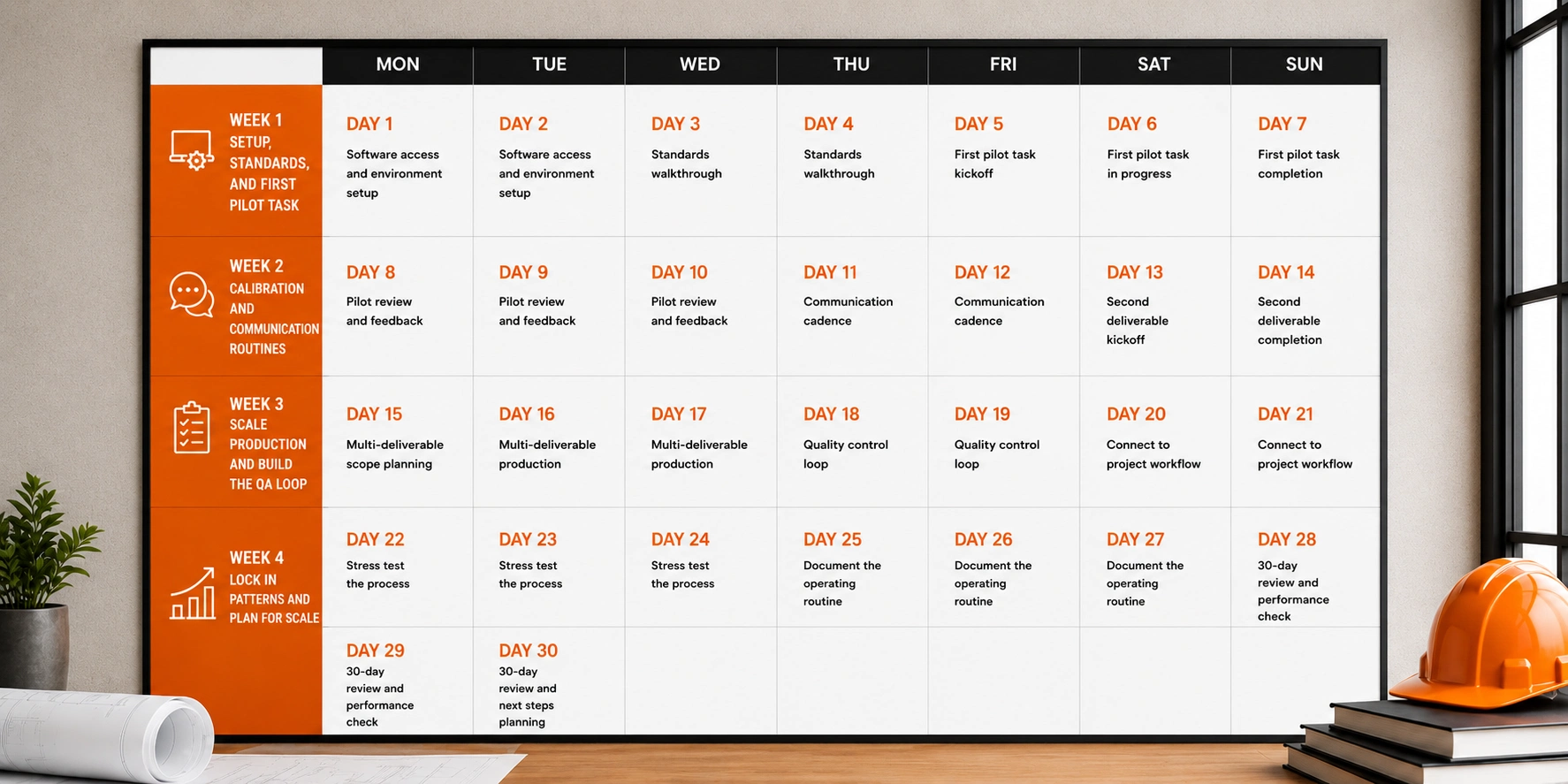
Week 1: Setup, Standards, and First Pilot Task
Week one is about transferring context. The outsourced team needs enough information about the firm’s standards, tools, and expectations to produce one small deliverable. Nothing more.
Day 1 to 2: Software access and environment setup
- Confirm software access for everyone on the outsourced team
- Verify version match with the firm’s project files
- Set up shared file environment, BIM 360, Autodesk Construction Cloud, or other
- Test file open, save, and sync from the outsourced team’s environment
- Provision access to the firm’s standards documentation
Day 3 to 4: Standards walkthrough
- Walk the outsourced team through the standards reference, do not assume they will read it cold
- Cover layer conventions, line weights, sheet naming, title block use
- Demonstrate one or two example deliverables that meet the standard
- Answer questions before production starts, not during
Day 5 to 7: First pilot task
Pick one small, low-risk deliverable. One sheet update, one detail, one workset setup, one schedule. The goal is not output volume. The goal is to surface mismatches in standards, software setup, and communication style before they multiply across many deliverables. Whether the work is Architectural drafting outsourcing, Revit modeling support, or BIM outsourcing, the pilot principle is the same: small first, scale second.
End of week one milestone: one deliverable produced, reviewed against standards, with a list of clarifications to address before week two.
Week 2: Calibration and Communication Routines
Week two turns the first deliverable into a pattern. The pilot work gets reviewed, standards questions get answered, and the team’s communication cadence gets locked in.
Day 8 to 10: Pilot review and feedback
- Walk through the pilot deliverable with the outsourced team
- Identify what matched the firm’s standards and what did not
- Document the corrections and the reasoning behind them
- Update the standards reference if any gaps were exposed
- Confirm the corrections will carry forward to future work
Day 11 to 12: Communication cadence
- Establish daily or twice-weekly check-in cadence
- Define how questions get routed and how fast answers are expected
- Decide which communication channel handles what, chat for quick questions, email for documented decisions, video for complex topics
- Set up a shared task tracker or punchlist that both sides can see
Day 13 to 14: Second deliverable
A second small deliverable, slightly larger than the first, tests whether the standards corrections carried forward. If they did, the engagement is on track. If they did not, address it directly before scaling up.
End of week two milestone: two deliverables completed, communication routines in place, and a documented set of standards clarifications agreed on by both sides.
Week 3: Scale Production and Build the QA Loop
Week three is where production volume starts to ramp. The outsourced team takes on multiple deliverables in parallel, and the firm builds the QA loop that will run for the rest of the engagement.
Day 15 to 17: Multi-deliverable scope
- Assign multiple deliverables in parallel, not one at a time
- Test how the team handles concurrent work and watch for bottlenecks in routing, questions, and reviews
- Adjust the routing process if any single person becomes a bottleneck
Day 18 to 19: Quality control loop
Every deliverable that comes back from the outsourced team should pass through a defined QA check before it is issued. A repeatable approach to quality control in architectural outsourcing covers what gets checked, who checks it, what counts as ready to issue, and how findings get tracked back to the outsourced team. The QA loop is what prevents errors from compounding over the lifecycle of the engagement.
Day 20 to 21: Connect to the broader project workflow
Outsourced production does not exist in isolation. The deliverables connect to the firm’s broader project workflow, including transmittals, revision tracking, and document control. Week three is when the outsourced team should start participating in those connected workflows, not just producing isolated deliverables.
End of week three milestone: production volume is ramping, QA is running on every deliverable, and outsourced work is connected to the firm’s project documentation flow.
Week 4: Lock In Patterns and Plan for Scale
Week four confirms that the patterns from weeks one through three will hold beyond the ramp. The engagement transitions from onboarding to ongoing production.
Day 22 to 24: Stress test
- Increase production volume to near full target capacity
- Watch for any breakdowns in standards, communication, or quality
- Document any new issues and resolve them before they become patterns
- Confirm the outsourced team can sustain the cadence
Day 25 to 27: Document the operating routine
- Write down how work gets routed in steady state
- Document the QA workflow, including who reviews what and at what cadence
- Capture the communication routines that worked, drop the ones that did not
- Update the standards reference with any clarifications added during the ramp
Day 28 to 30: 30-day review
A formal review at the end of the first month covers four things: deliverable quality, the outsourced team’s responsiveness, the firm’s internal management overhead, and alignment between outsourced production and the firm’s broader workflow. This review is the decision point on whether to scale further, hold steady, or reconsider.
End of week four milestone: the engagement is producing at near full capacity, the operating routine is documented, and the firm has enough evidence to make a confident decision about scaling.
30-Day Onboarding Milestones at a Glance
| Week | Focus | End-of-week milestone |
| Week 1 | Setup, standards transfer, first pilot task | One deliverable produced and reviewed |
| Week 2 | Pilot review, calibration, communication routines | Two deliverables and locked-in communication cadence |
| Week 3 | Multi-deliverable scope, QA loop, project workflow connection | Production ramping with active QA |
| Week 4 | Stress test, document operating routine, 30-day review | Steady-state operations and a clear scale-up decision |
Common Onboarding Mistakes That Slow Everything Down
Most onboarding problems trace back to a small set of recurring mistakes.
Skipping the standards documentation step
Firms that have never written down their standards expect the outsourced team to figure them out. The team cannot. The cycle of inconsistent work and rejection repeats until someone documents the standards. Doing this before day 1 is faster than doing it during week 3 of rework.
Loading the team with a full project on day 1
Handing a fully loaded permit set to a brand new outsourced team is one of the most common ramp-up mistakes. Skipping the pilot does not save time. It moves the troubleshooting from day 5 to day 25, when the cost of correction is much higher.
Multiple internal owners routing work
When three or four different project leads are sending tasks to the outsourced team without coordination, the result is duplicated work, conflicting priorities, and standards drift. One internal point of contact during onboarding is non-negotiable.
Treating the outsourced team as a black box
An outsourced team that produces deliverables and never gets feedback will keep producing the same patterns indefinitely. Short, regular reviews during the first month are the fastest way to lock in alignment.
Skipping the 30-day review
Firms that do not pause at day 30 to evaluate the engagement miss the cleanest opportunity to course-correct. Without a structured review, problems accumulate quietly and only become visible when they are expensive to fix.
Treating onboarding as a one-time event
Onboarding is not done at day 30. It transitions into a steady-state operating routine. Firms that treat the first month as the only investment in alignment usually find the relationship deteriorates. Light-touch standards updates, refresher reviews, and ongoing feedback are part of how it stays healthy.

How Virtual Construction Assistants (VCA) Approaches Onboarding
Virtual Construction Assistants (VCA) treats onboarding as a structured 30-day ramp, not a paperwork formality. The first month is built around the same principles outlined above: standards transfer, pilot deliverables, calibration, and a quality control loop established before production scales.
What a construction virtual assistant trained in architectural production typically completes during onboarding:
- Software environment setup matched to the firm’s version and add-in stack
- Standards walkthrough with the firm’s documented reference
- Pilot deliverable selected with the firm’s internal point of contact
- Communication cadence and routing protocol established
- QA loop defined for ongoing deliverables
- Connection to broader project workflows, transmittals, document control, revision tracking
- 30-day review with the firm to confirm fit and discuss scale-up
Firms that get the most out of the relationship invest in the first 30 days seriously: documented standards, a clear point of contact, and a willingness to start small. The investment pays back many times over the life of the engagement.
Frequently Asked Questions
Can a 30-day onboarding really get an outsourced team to full production?
Yes, when the firm comes to day 1 with documented standards, software access ready, and a single internal owner. The 30 days are spent calibrating to the firm’s specific conventions, not learning architectural production from scratch. Without those prerequisites, 30 days is not enough.
What if the firm has never documented its standards?
Then documenting them is the first step before the outsourced engagement begins. A working standards reference can be drafted in a few days by a senior staff member, and it pays back across every future engagement.
How much internal time does onboarding take?
Plan for 5 to 10 hours per week of internal management time during the first month, weighted toward weeks one and two. This includes standards walkthroughs, pilot review, communication setup, and the 30-day review. By week four, internal time should be dropping toward steady-state levels.
Should multiple projects be assigned during onboarding?
No. One project is the right scope for the first 30 days. Adding a second project mid-onboarding multiplies the standards questions and dilutes the calibration. Add the second after the 30-day review.
What if the pilot deliverable does not meet expectations?
That is what the pilot is for. The first deliverable from a new outsourced team almost always has gaps. The question is whether those gaps close after one feedback cycle. If they do, the engagement is on track. If the same issues persist after two or three feedback cycles, that is a signal to reconsider the fit.
Does this onboarding plan apply to BIM coordination engagements?
Yes, with a slight shift in emphasis. BIM coordination onboarding spends more of week one and two on the BIM execution plan, file federation setup, and clash workflow definition. The four-week structure stays the same.
Build the First 30 Days Around the Patterns That Will Last
The first month of an outsourcing engagement is not just paperwork and software access. It is where the patterns that define the relationship for the next year get established. Firms that invest in those 30 days end up with production capacity that scales cleanly. Firms that skip the ramp end up troubleshooting forever.
Virtual Construction Assistants (VCA) supports architecture firms through a structured onboarding process built around a dedicated architectural virtual assistant trained in production drafting, Revit modeling, BIM coordination, and the construction administrative workflows that surround the drawings. The work stays inside your standards, your file environment, and your direction at every stage of the ramp.